

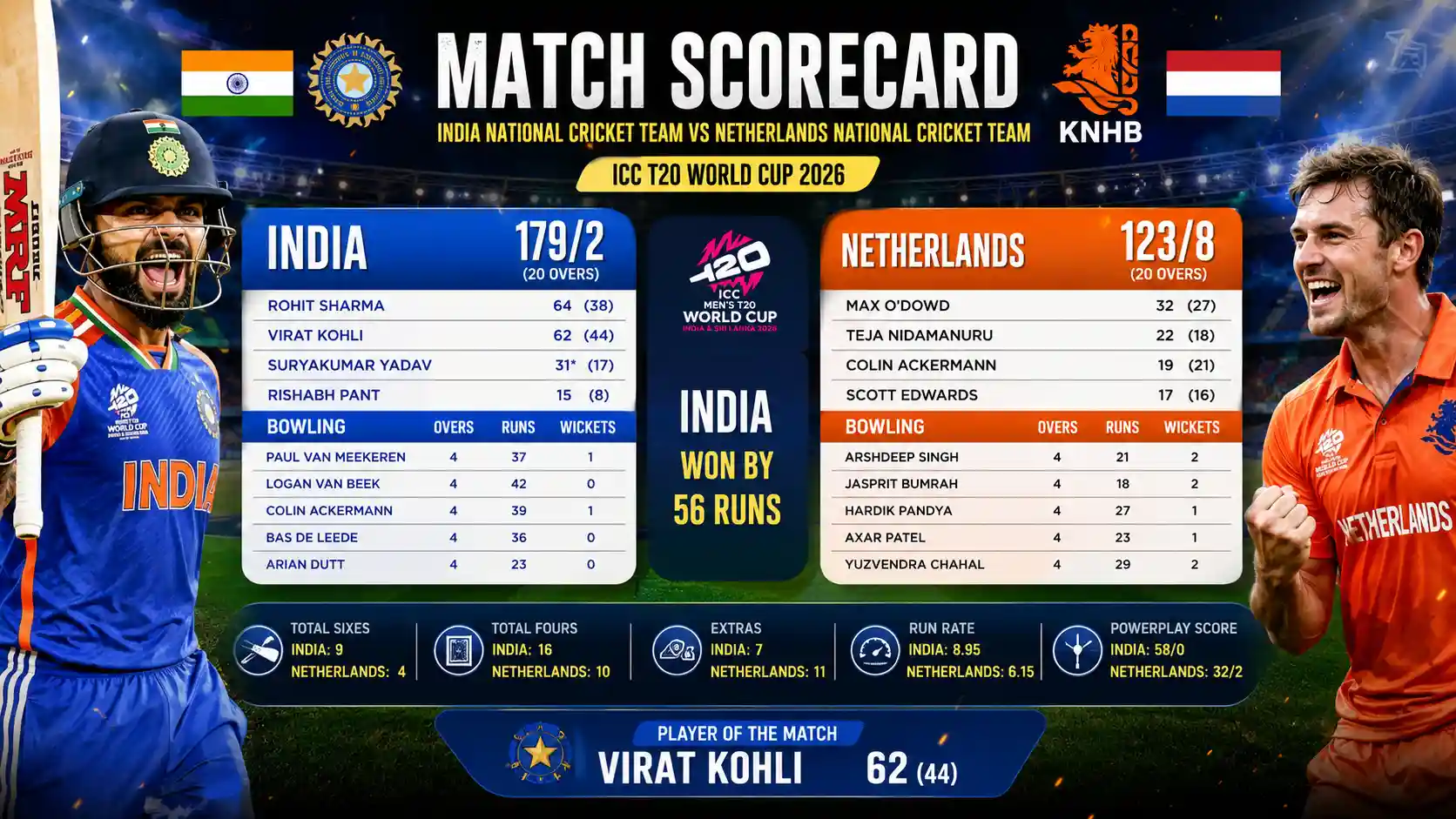
The India national cricket team vs Netherlands national cricket team match scorecard from the 2023 ODI World Cup in Bengaluru doesn’t just show a 410/4 and a 160-run win – it captures how India used a group-stage dead rubber to flex batting depth, experiment with bowling options, and announce knockout readiness. This guide breaks down the full scorecard, key statistics, partnerships, and tactical layers behind one of the most dominant wins of the tournament.
India vs Netherlands Match Scorecard Summary
The quickest way to understand the game is simple: India posted 410/4 in 50 overs, then bowled out Netherlands for 250, securing a 160-run victory and completing a perfect 9-0 group-stage record. This section gives a clean, snippet-friendly scoreboard view before we dive into analysis.
India Innings: Top Order and Middle Order Domination
In the India national cricket team vs Netherlands national cricket team match scorecard, India’s batting card looks like a statement of intent rather than just another group-stage outing. The top order and middle order combined to turn a good batting pitch into a nightmare chase.
- Rohit Sharma provided a brisk start at the top, scoring a fluent fifty that set the tempo.
- Shubman Gill matched Rohit’s aggression, adding a rapid half-century and putting the Netherlands’ new-ball attack under extreme pressure.
- Virat Kohli added a controlled fifty, acting as the bridge between a blazing start and the middle-order onslaught.
- Shreyas Iyer produced a commanding century, staying unbeaten and rotating strike before shifting into full power-hitting mode.
- KL Rahul blasted a lightning-quick hundred in the death overs, turning a big total into a psychological marker.
This batting sequence is exactly why the India national cricket team vs Netherlands national cricket team match scorecard has become a reference point for India’s World Cup batting blueprint.
Netherlands Innings: Resistance Inside a Hopeless Chase
On the other side of the scorecard, Netherlands’ chase never truly threatened the target but still had pockets of fight.
- Early wickets kept them under pressure, even as they tried to maintain a positive run rate.
- Middle-order batters dug in to avoid collapse and pushed the team towards a respectable total.
- A late flourish from a lower-middle-order batter added sixes and lifted the team to 250, but the required rate had already turned impossible.
The numbers show that despite scattered resistance, the india national cricket team vs netherlands national cricket team match scorecard is fundamentally one-sided; the gap between the sides is measured in quality, depth, and tactical clarity.
Key Batting Performances: Centuries and Fifties That Defined the Game
This section explains why each big score in the India national cricket team vs Netherlands national cricket team match scorecard mattered in context, not just as a statistic.
Top Order Platform: Rohit, Gill and Kohli
For snippet-friendly clarity: India’s top three all scored fifties and built an ideal platform for a 400-plus total.
- Rohit Sharma’s bold intent in the powerplay forced Netherlands to change plans early. His quick scoring opened up field placements and ensured the run rate never fell out of control.
- Shubman Gill’s elegant attack against both pace and spin turned the first 10 overs into a mini demolition, proving why he is seen as the modern anchor-aggressor in India’s ODI setup.
- Virat Kohli’s measured fifty looked less explosive on paper but was critical in maintaining stability after wickets, giving Shreyas Iyer a safe runway to build his innings.
Without this top-order platform, the India national cricket team vs Netherlands national cricket team match scorecard would look like a solid total, not a crushing 410.
Middle Order Masterclass: Shreyas Iyer and KL Rahul
The true story of the match lives in the middle-order numbers.
- Shreyas Iyer’s century came with a blend of classic strokeplay and aggressive hitting. He started by finding gaps, then began clearing the ropes once he was set, proving his value as a No. 4 who can both repair and destroy.
- KL Rahul’s rapid hundred in the final overs transformed the innings from dominating to demoralizing. His acceleration ensured India didn’t just cross 350; they smashed past 400 with authority.
If you look at the India national cricket team vs Netherlands national cricket team match scorecard in isolation, you see big numbers. When you understand their timing and sequencing, you see a team deliberately stretching its batting ceiling before knockout rounds.
Bowling Figures: India’s Attack and Experimental Overs
Scorecards often reduce bowling to overs, runs, and wickets. Here’s why the bowling card in the India national cricket team vs Netherlands national cricket team match scorecard is more revealing than usual.
Read more: India National Cricket Team vs Netherlands National Cricket Team Match Scorecard
Core Bowlers: Seam and Spin Control
India’s main bowlers did exactly what a top side should do while defending 410.
- Frontline pacers struck early, restricting scoring options and ensuring Netherlands could not build a platform that might make the chase interesting.
- Main spinners took control of the middle overs, using variations and subtle changes of pace to extract mistakes from batters trying to push the rate.
- The combined figures show an attack that never needed to overreach; they simply maintained pressure and waited for chances.
These bowling returns give the India national cricket team vs Netherlands national cricket team match scorecard its symmetry: a dominant batting card on one side and a composed, clinical bowling card on the other.
Part-Time Options and Role Experiments
One of the most intriguing elements in this match was India’s choice to use multiple part-time bowlers.
- Additional bowling options like occasional seamers and part-time spinners were given overs despite the match already being under control.
- This move allowed the team management to test roles in a low-risk environment, evaluating who could offer an extra over or two in future games.
- The scorecard shows overs from players who rarely bowl in major tournaments, sending a clear signal about flexibility and experimentation.
From a tactical standpoint, this layer of the India national cricket team vs Netherlands national cricket team match scorecard highlights India’s focus on building redundancy and variety in their attack.
Partnership Analysis: How the Innings Was Built
Partnerships are often the hidden architecture behind big totals. The India national cricket team vs Netherlands national cricket team match scorecard reveals a sequence of stands that steadily dismantled Netherlands’ plans.
Opening Stand: Crushing the New Ball Challenge
India’s opening partnership established immediate control.
- The first wicket stand raced towards three figures, taking advantage of a good batting surface and punishing any loose deliveries.
- Netherlands’ strategy to mix pace and spin in the powerplay backfired as both openers attacked with confidence, shrinking the margin for error.
This initial burst meant that all later partnerships could operate from a position of strength rather than damage control.
Middle and Lower-Middle Partnerships: From Platform to Carnage
The crucial partnerships came through the middle:
- Kohli and Iyer stitched together a stabilizing stand that prevented the innings from stalling after early wickets.
- Iyer and Rahul’s partnership transformed a strong score into a massive one; their combined aggression in the late overs pulverized the attack and erased any doubt about the final total crossing 400.
When you break down the India national cricket team vs Netherlands national cricket team matches scorecard by partnerships, you see a classic ODI progression: platform, consolidation, explosion.
Tactical Match Context: Why This Game Mattered for India
A raw scoreboard can make this look like a routine thrashing. In reality, the India national cricket team vs Netherlands national cricket team match scorecard carries strategic weight.
Knockout Preparation and Confidence
This fixture was India’s final group game, with qualification already secured.
- By choosing an aggressive batting template and backing every top-order batter to go hard, India established a clear game model for high-scoring venues in knockout matches.
- The success of the middle order under low pressure removes lingering questions about how the side might cope if early wickets fall in bigger games.
The scorecard becomes a confidence bank: every key batter has numbers to lean on when pressure rises later.
Tactical Flexibility in Bowling
On the bowling side:
- Using more bowlers than usual provided the captain with extra information on who can be trusted for specific match-ups.
- Giving overs to part-timers in a World Cup fixture shows a willingness to expand the bowling menu, important against different oppositions and pitches later in the tournament.
The India national cricket team vs Netherlands national cricket team match scorecard thus doubles as a tactical experiment log for India’s think tank.
Pitch, Venue and Conditions: How Bengaluru Shaped the Numbers
The venue plays a central role in interpreting this match.
Batting-Friendly Surface and Short Boundaries
Bengaluru’s surface and dimensions helped India maximize their batting skill set.
- True bounce and predictable pace allowed batters to play through the line with full commitment, encouraging high-risk, high-reward strokes.
- Short boundaries meant mistimed hits still carried for fours and sixes, which is reflected in the heavy scoring rate and high boundary count.
The result is an India national cricket team vs Netherlands national cricket team match scorecard that looks inflated compared to low-scoring venues, but perfectly in line with the ground’s reputation.
Netherlands’ Challenge Against Conditions
For the Netherlands, the same conditions magnified every small error.
- Misjudged lengths were punished, especially in the death overs when India’s power hitters were set.
- With limited high-pace options and fewer proven death bowlers, controlling such a batting lineup at this venue was always going to be a steep task.
Understanding the pitch and venue context is essential if you want your article about the India national cricket team vs Netherlands national cricket team match scorecard to feel like serious analysis rather than a mere recap.
Psychological and Strategic Impact on Both Teams
Beyond numbers, scorecards carry a psychological imprint.
India: Dominance Reinforced
For India:
- A 160-run win on the back of 410 runs strengthens the narrative of a side that is technically and mentally superior to most opponents in the group phase.
- Centuries for middle-order batters and fifties for the top three mean confidence is widely distributed, reducing dependence on any single star.
This match added another layer of intimidation to India’s profile, which matters when oppositions prepare plans for the knockouts.
Netherlands: Experience, Lessons and Respectable Fight
For the Netherlands:
- Facing a powerhouse side under World Cup lights provides data and experience that can shape their future tactics against stronger teams.
- Showing resistance with the bat, reaching a total that doesn’t look embarrassing on paper, builds internal belief despite the margin of defeat.
The India national cricket team vs Netherlands national cricket team match scorecard is thus a tale of one-sided dominance in the result column but mixed outcomes in terms of growth and learning.
How This Match Fits Into India’s World Cup Campaign Narrative
No article about this scorecard is complete without placing it within the campaign story.
Perfect Group Stage Record
This match sealed India’s unbeaten run through the group stage.
- A flawless record boosts morale and shrinks doubt ahead of knockouts.
- Scorecards like this one show that India didn’t just scrape through; they overpowered teams with clear margins.
Template for Future Matches
The india national cricket team in the Netherlands national cricket team match scorecard acts as a blueprint.
- Aggressive, fearless top-order batting.
- Middle order capable of converting platforms into huge totals.
- Flexible bowling attack able to defend big scores without panic.
This becomes a reference game for selectors, coaches, and analysts when they discuss India’s best XI and ideal strategies on true pitches.
Frequently Asked Questions:
What was the final score in the India vs Netherlands World Cup 2023 match?
India scored 410/4 in 50 overs, while the Netherlands were all out for 250, giving India a 160-run victory.
Who scored centuries for India against Netherlands in the 2023 World Cup?
Shreyas Iyer and KL Rahul both scored centuries, with Iyer remaining unbeaten and Rahul accelerating in the death overs.
How did India’s top order perform in this match?
India’s top three – Rohit Sharma, Shubman Gill and Virat Kohli – each made fifties, providing a dominant platform for the middle order.
What is the significance of the india national cricket team vs netherlands national cricket team match scorecard for India’s campaign?
The scorecard reflects India’s perfect group stage, showcasing batting depth, bowling variety and tactical experimentation ahead of knockouts.
How many runs did Netherlands score while chasing 410?
Netherlands reached 250, showing patches of resistance but never truly threatening the target.
Which Indian bowlers were most effective against Netherlands?
India’s frontline pacers and spinners shared wickets throughout the innings, with each playing a role in maintaining constant pressure.
Did India use any part-time bowlers in the India vs Netherlands match?
Yes, India used part-time options in addition to regular bowlers, testing different roles and expanding tactical flexibility.
Where was the India vs Netherlands World Cup 2023 match played?
The match took place at a batting-friendly venue with short boundaries, contributing to the high-scoring nature of the game.
How did KL Rahul’s innings influence the final total?
KL Rahul’s rapid century in the final overs pushed India from a strong score to an intimidating 410, breaking the Netherlands’ morale.
What does the india national cricket team vs netherlands national cricket team match scorecard tell us about India’s batting strategy?
It shows a clear three-phase plan: aggressive powerplay, stable middle overs, and explosive death overs, with every major batter contributing significantly.
