

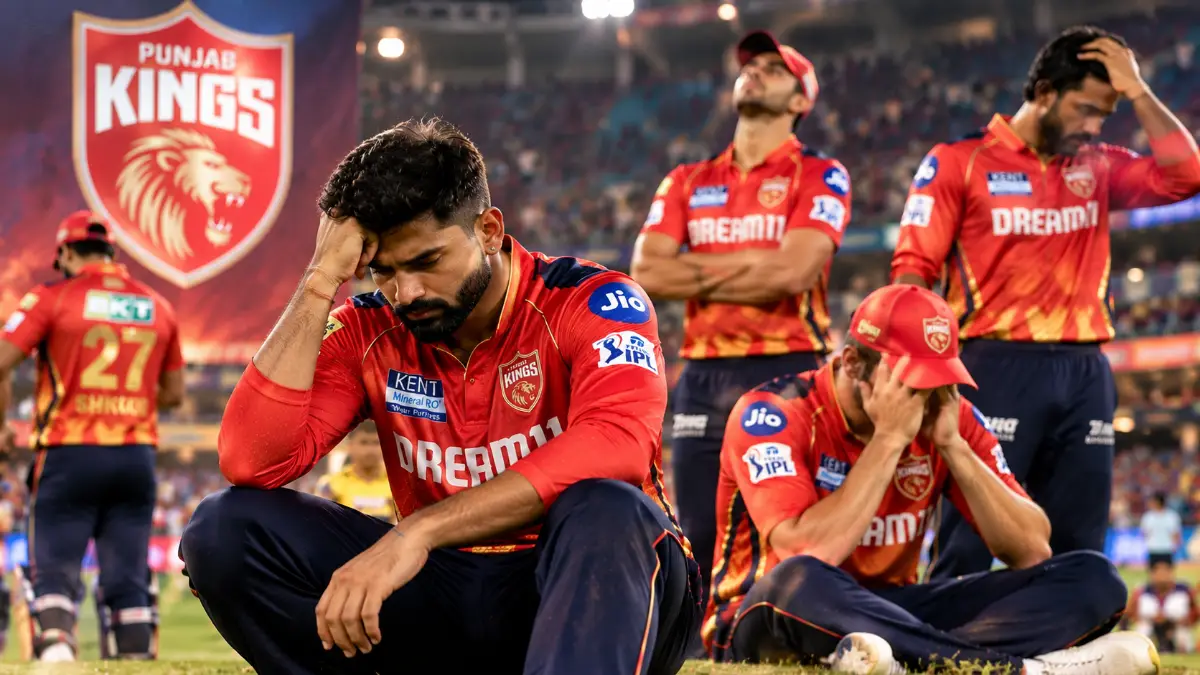
The constant wicket-taking, particularly its declining effectiveness in the second half of the 2026 Indian Premier League (IPL), as well as too many dropped catches, too many changes in combinations, and planned batting failures to help their scores along, were often cited when Punjab Kings (PBKS) kept losing. The IPL is the biggest franchise Twenty20 cricket league in India.
The turnaround was dramatic. Winning six of the first seven matches, Punjab topped the standings for 22 straight days and seemed well on course for the playoffs. Then came six straight defeats. Despite boasting one of the most electrifying batting line-ups in the tournament, PBKS ended up finishing 5th and missed out on making it to the playoffs with 15 points.
| Question | Quick answer |
| Why is PBKS losing? | Bowling, fielding, and second-half instability were major problems |
| Season | IPL 2026 |
| Final position | 5th |
| Final points | 15 |
| Early-season record | 6 wins from first 7 games |
| Consecutive losses | 6 |
| Wickets taken | 64 |
| Bowling economy | 10.40 |
| Dropped catches | 16 |
| Qualified for playoffs? | No |
Why Is PBKS Losing in IPL 2026?
No, there was zero reason for the decline of Punjab. Bowling was the most obvious analytics deficiency too: PBKS took far fewer wickets and gave up runs at an expensive rate, unable to generate enough dot-ball pressure. The errors in the field made it more difficult to recover from those problems.
It is an important point of distinction that Punjab was not consistently being outplayed with the bat. PBKS provided its bowlers with low domain totals that ought to have guaranteed the contest, as opposed to giving them away in a cakewalk in a few matches.
- Read more: Why is PBKS losing?
The batting wasn’t Punjab’s biggest problem.
Punjab’s batting was frequently excellent. PBKS crossed 200 ten times during IPL 2026, showing how effectively its top order could attack.
Prabhsimran Singh, Priyansh Arya, Shreyas Iyer and Cooper Connolly were among the players who helped make the lineup dangerous. The team could accelerate quickly and put opponents under immediate scoreboard pressure.
But scoring 200 loses some of its value when the opposition believes it can chase 210 or 220.
That became Punjab’s central problem: the batting often created winning opportunities, but the team couldn’t consistently convert those opportunities into wins.
The bowling attack couldn’t consistently control games
Punjab finished the season with only 64 wickets. More concerning were the efficiency numbers.
PBKS recorded a team bowling average of 42.54, an economy rate of 10.40 and a dot-ball percentage of only 29.2%. Season reviews ranked Punjab ninth for wickets and last for bowling average, economy and dot-ball percentage.
For readers less familiar with cricket statistics, an economy of 10.40 means Punjab conceded more than ten runs per six-ball over on average. Over 20 overs, that scoring rate projects beyond 200.
Without regular wickets or quiet overs, opposition batters rarely had to change their approach.
Fielding mistakes made the bowling problems worse.
Punjab reportedly dropped 16 of 56 catching opportunities during the season.
A dropped catch does more than add one mistake to a fielding column. The bowler loses a potential wicket, the batter receives another opportunity, the partnership continues, and the opposition can attack later overs with more wickets available.
For an already expensive bowling unit, those extra opportunities were particularly damaging.
- Read more: Why is PBKS losing?
How Did PBKS Go From Table-Toppers to Missing the Playoffs?
Punjab’s final position doesn’t fully explain how dramatic its season was. This was not a team that struggled from opening day. It was one of the strongest sides early in the tournament before its results changed sharply.
Punjab Kings’ dominant start
PBKS won six of its opening seven matches, with the other game ending without a result. Punjab remained at the top of the standings for 22 consecutive days.
That start also followed a run to the 2025 IPL final, so the early success did not look like a short-lived surprise.
The batting was aggressive, victories created momentum, and Punjab appeared to have built on the previous season.
Then the weaknesses behind the strong results became increasingly difficult to hide.
The Rajasthan Royals defeat exposed the warning signs
The April 29 match against Rajasthan Royals became an important turning point.
Punjab scored 222/4, the type of first-innings total that normally gives a bowling attack room to operate. Rajasthan nevertheless completed the chase and won by six wickets.
Three major PBKS pace options-Arshdeep Singh, Lockie Ferguson and Marco Jansen-combined to concede 166 runs in 11.2 overs.
The significance of that defeat was straightforward: Punjab’s batting had done its job, yet even 222 wasn’t enough.
Six consecutive defeats changed the season.
The Rajasthan loss developed into a prolonged decline rather than an isolated bad night.
Punjab lost six consecutive matches. Different games exposed different weaknesses: in some, the bowling failed to defend a strong total; in others, early wickets placed too much pressure on the batting lineup.
The season therefore followed a striking progression:
Strong start → First defeat → Bowling problems intensify → Six-match losing streak → Playoff pressure → Final league game → Fifth-place finish
By the time PBKS recovered, qualification was no longer entirely under its control.
- Read more: Why is PBKS losing?
Was Bowling the Biggest Reason PBKS Kept Losing?
The numbers strongly indicate that bowling was Punjab’s biggest measurable weakness.
| Bowling indicator | PBKS | IPL rank | Why it matters |
| Wickets | 64 | 9th | Too few breakthroughs |
| Bowling average | 42.54 | 10th | Too many runs per wicket |
| Economy | 10.40 | 10th | Opponents scored freely |
| Dot-ball percentage | 29.2% | 10th | Limited scoreboard pressure |
PBKS struggled to take enough wickets
Wickets are one of the most effective ways to slow a T20 innings because a new batter normally needs at least some time to adjust.
Punjab took only 64.
That meant opponents were often able to preserve partnerships and attack with wickets still available. A bowling side that neither removes batters nor restricts scoring leaves itself with very little margin for error.
The economy rate created constant pressure.
Punjab’s 10.40 economy rate meant opponents could score quickly without necessarily taking extreme risks.
Think of economy rate as the cricket equivalent of defensive efficiency. A bowler does not need a wicket every over to be valuable; an over costing four or five runs can increase the pressure on the batting team.
PBKS simply did not produce enough of those controlled periods.
PBKS couldn’t create enough dot-ball pressure
A dot ball is a delivery from which no run is scored.
Punjab’s reported dot-ball percentage was only 29.2%. That matters because dot balls force the required scoring rate upward. Several dots in succession can push a batter toward a riskier shot, which in turn creates wicket opportunities.
Punjab too often allowed opponents to keep the scoreboard moving.
- Read more: Why is PBKS losing?
Death bowling became particularly costly
The final five overs-overs 16 through 20-are known as the death overs.
Punjab’s death bowling became another major concern. Post-season analysis put its economy in this phase at roughly 11.7 runs per over.
The issue wasn’t merely conceding boundaries. PBKS often entered the closing overs without having taken enough earlier wickets, allowing established batters to attack freely.
Why Couldn’t PBKS Defend Big Scores?
Modern IPL batting has changed expectations around what constitutes a safe total. A score of 200 is formidable, but it is no longer automatically match-winning.
Punjab experienced that reality repeatedly.
Scoring 200 was no guarantee of victory.
PBKS reached 200 ten times during the season, yet its overall results did not reflect that extraordinary scoring frequency.
That creates an important distinction:
Scoring 200 shows batting strength. Needing 220 or more to feel safe can reveal a bowling weakness.
Punjab increasingly looked like a team that needed an exceptional batting performance simply to give its bowlers enough protection.
The 222/4 defeat against Rajasthan
The Rajasthan game provides the clearest example.
PBKS: 222/4 → Rajasthan completed the chase → PBKS lost by six wickets.
Punjab could reasonably expect 222 to create significant scoreboard pressure. Instead, Rajasthan maintained the scoring rate and exposed the difficulty PBKS had slowing a chase once opponents established momentum.
What repeated failed defenses reveal.
The broader problem was not confined to one phase.
When Punjab failed to take early wickets, opponents entered the middle overs with a strong platform. When middle-over pressure was absent, established batters reached the death overs. And when that happened, Punjab’s expensive closing overs became even harder to survive.
That sequence explains the problem more accurately than simply saying PBKS “bowled badly.”
| Example | PBKS performance | Result | Main issue | Critical area |
| vs RR | 222/4 | Lost by 6 wickets | Failed defense | Bowling |
| vs GT | 163/9 | Lost | Batting + defense | Combination |
| vs SRH | 202/7 | Lost | Runs conceded | Bowling |
| vs DC | 210/5 | Lost | Failed defense | Bowling |
| vs MI | 200/8 | Lost | Failed defense | Bowling |
| vs RCB | 199/7 chasing 223 | Lost by 23 runs | Early wickets | Powerplay |
Against Royal Challengers Bengaluru, for example, the problem changed. Chasing 223, Punjab fell to 19/3 inside four overs before recovering to 199/7. That defeat demonstrates why bowling cannot explain every loss.
- Read more: Why is PBKS losing?
Did PBKS Underuse Spin Bowling?
Punjab’s bowling problems also raise a tactical question: did the team become too dependent on pace?
Punjab relied heavily on pace.
PBKS spinners reportedly bowled only 59 overs during the season, the fewest among the teams.
That doesn’t automatically mean more spin would have produced more victories. Conditions, matchups and individual form all influence bowling choices.
It does, however, show how heavily Punjab depended on its pace combinations despite their difficulty controlling runs.
What happened with Yuzvendra Chahal?
Yuzvendra Chahal finished with 12 wickets in 14 matches, but his raw numbers require context.
Season analysis reported that eight catches were dropped from his bowling. A bowler cannot control whether a legitimate wicket opportunity is completed by a fielder.
That doesn’t erase every expensive spell, but it illustrates why bowling figures and fielding performance need to be analyzed together.
Could Harpreet Brar have played more?
Harpreet Brar offered another spin option but had limited opportunities.
It is impossible to say that selecting Brar more frequently would have reversed Punjab’s season. What can reasonably be questioned is whether PBKS had enough variation when its pace-heavy strategy repeatedly became expensive.
How Much Did Poor Fielding Cost Punjab Kings?
Fielding was one of the clearest supporting causes of the collapse.
Punjab dropped 16 catches.
PBKS reportedly converted 40 of 56 catching opportunities, meaning 16 went down.
In a T20 match, one missed opportunity can transform an innings. Dropping an aggressive batter early may give that player another 20, 30, or 50 runs.
Dropped catches also hurt bowling figures
The effect can be visualized as a chain:
Dropped catch → Batter survives → Partnership continues → Additional runs → Lost wicket opportunity → More pressure on later overs
This is particularly important when judging Punjab’s bowlers. Some poor figures reflected poor deliveries, but fielding failures also denied the attack chances it had legitimately created.
Which dropped catches were most expensive?
A useful way to measure fielding damage is to record a batter’s score when dropped and compare it with the eventual score.
For example:
Runs after dropped chance = Final score − Score when dropped
That number doesn’t prove those runs would have disappeared if the catch had been taken, but it provides a useful measure of the opportunity’s potential cost.
Punjab’s reported eight dropped catches from Chahal’s bowling alone show why this deserves attention beyond a simple season catch total.
Did Constant Team Changes Hurt PBKS?
Selection stability became another issue as Punjab searched for solutions.
Published analysis counted 15 lineup changes across seven matches during the second half of the season.
How often did Punjab change the XI?
Those changes reflected attempts to find better combinations while results deteriorated.
The constant movement affected the balance around players such as Arshdeep Singh, Marco Jansen, Yuzvendra Chahal, Harpreet Brar, Lockie Ferguson and Vijaykumar Vyshak.
Why bowling combinations became difficult to settle
T20 bowling attacks depend heavily on clearly defined roles.
One bowler may attack with the new ball. Another controls the middle. A specialist may be reserved for overs 18 and 20.
When personnel frequently change, establishing those patterns becomes harder. Punjab was trying to solve performance problems while simultaneously determining its best combination.
Correlation doesn’t automatically mean causation.
The 15 lineup changes should not be treated as proof that selection caused the losing streak.
Some changes can be responses to poor performances rather than their cause. Injuries, pitch conditions, opposition matchups, and availability also influence team selection.
The more defensible conclusion is that instability accompanied Punjab’s decline and made it harder to establish consistent roles.
Did Punjab’s Home-Venue Change Affect Their Form?
Venue context provides another possible piece of the puzzle.
PBKS at Mullanpur
Punjab’s early home performances at Mullanpur coincided with its strong opening stretch.
The team looked comfortable with its combinations and carried momentum from match to match.
PBKS at Dharamsala
Later, Punjab played three matches at Dharamsala and lost all three during its decline.
Different grounds can change boundary dimensions, pace, bounce, swing, and the value of particular bowling styles.
Venue problem or underlying team problem?
It would be misleading to blame the collapse on Dharamsala alone.
The same structural issues-high bowling economy, limited wicket-taking, and fielding errors-appeared beyond one venue.
The venue change may have complicated Punjab’s adjustment, but the season-long numbers indicate a broader bowling problem rather than a purely geographical one.
Was PBKS’s Batting Really Good Enough?
Although the batting was clearly stronger than the bowling, it was not perfect.
The top order remained a major strength.
Prabhsimran Singh and Priyansh Arya helped provide aggression near the top, while Shreyas Iyer and Cooper Connolly contributed to a lineup capable of producing imposing totals.
Punjab’s ten 200-plus scores are the simplest evidence of that strength.
Middle-order inconsistency created another weakness
The deeper issue emerged when the top order failed.
Punjab did not always receive the same consistency from positions five through seven. Marcus Stoinis and other middle-order options could provide power, but the unit did not consistently rescue difficult starts.
The RCB defeat demonstrated this vulnerability: falling to 19/3 made a 223-run chase exceptionally difficult despite the eventual recovery.
Punjab became too dependent on huge totals
This leads to perhaps the most revealing question about PBKS’s batting:
Did Punjab need to score 220 simply because 190-200 didn’t provide enough protection?
At times, the answer appeared to be yes.
That is not a sustainable formula. Even an elite T20 batting lineup will occasionally make 170 or 180. A balanced team needs a bowling attack capable of winning those games too.
PBKS First Half vs Second Half – What Actually Changed?
The most useful way to understand Punjab’s season is not through its final record alone, but through the contrast between its opening stretch and what followed.
| Metric | Early-season pattern | Second-half pattern |
| Results | 6 wins in first 7 games | Six consecutive defeats later |
| Batting | High-scoring and aggressive | Still capable of 200+ |
| Bowling | Weakness partly masked by wins | Became decisive |
| Wicket pressure | Manageable early | Increasing concern |
| Fielding | Errors present | Costlier during defeats |
| Selection | Greater continuity | Frequent changes |
| Playoff position | Top of standings | Fell to 5th |
The crucial point is that Punjab’s batting did not simply disappear.
Instead, weaknesses that winning performances had initially masked became increasingly costly. Once the bowling couldn’t contain opponents, dropped chances and lineup changes reduced the team’s margin for recovery.
What Could Punjab Kings Have Done Differently?
There is no tactical change that guarantees a different result, but the 2026 numbers highlight several areas Punjab could reasonably have addressed.
Establish a more reliable death-bowling combination.
Punjab needed clearer closing-over roles and at least one bowler capable of consistently limiting boundaries at the death.
The solution isn’t simply “find a fast bowler.” Accuracy, slower-ball variation, yorker execution, and matchup flexibility are equally important.
Generate more middle-over wickets.
More wicket pressure between overs 7 and 15 could have prevented established batters from reaching the death overs.
A better balance between pace and spin was one possible route.
Improve catching and fielding consistency
This is the most straightforward improvement.
Taking more of the chances already being created would immediately improve the bowling attack without requiring a tactical overhaul.
Create greater lineup stability.
Punjab also needed clearly defined roles.
Stability does not mean refusing to change a losing team. It means players understanding when they will bowl, where they will bat,t and what tactical responsibility they hold.
The Biggest Content Gaps Other PBKS Articles Miss
Looking only at Punjab’s final position misses the most interesting questions behind the collapse.
Was the collapse really caused by bowling?
The evidence strongly points toward bowling as the largest measurable weakness.
Punjab could score heavily but finished near the bottom of major bowling indicators. That imbalance explains why high totals did not translate into enough victories.
How many runs did dropped catches actually cost?
This requires ball-by-ball analysis rather than guesswork.
For every dropped catch, record:
Batter’s score when dropped → Final score → Additional runs after chance
The total should be labeled “runs scored after dropped chances,” not “run cost directly,” because cricket does not allow us to know what would otherwise have happened.
Which phase of an innings hurt PBKS most?
A phase comparison provides a better diagnosis than season economy alone:
| Phase | Overs | What to measure |
| Powerplay | 1-6 | Wickets + economy |
| Middle | 7-15 | Dot balls + wickets |
| Death | 16-20 | Economy + boundaries conceded |
Punjab’s reported death economy of around 11.7 suggests the final phase deserves particular attention, but all three phases need to be considered together.
Did PBKS lose because opponents adapted?
It is tempting to say opponents simply “figured Punjab out,” but that requires evidence.
A stronger explanation is that opponents increasingly exploited weaknesses PBKS struggled to correct: insufficient bowling pressure, expensive overs, and missed fielding opportunities.
Venue, matchup,p and tactical data would be needed before claiming a league-wide strategic adjustment against Punjab.
Why Did PBKS Miss the IPL 2026 Playoffs?
Punjab finished fifth with 15 points, one point short of the playoff cutoff.
The six-match losing streak did most of the damage. PBKS remained mathematically alive late in the season, but its earlier defeats meant qualification increasingly depended on other teams’ results.
That is what makes the season especially frustrating from Punjab’s perspective. A team that began 6-0 in completed matches and spent weeks leading the standings ultimately failed to finish inside the top four.
The problem wasn’t one decisive elimination game. It was the accumulation of losses during the second half.
What Does PBKS Need to Improve for IPL 2027?
Punjab does not need to rebuild everything. The 2026 season demonstrated that its batting foundation can produce enough runs to compete.
The priority should be creating a more balanced side.
| 2026 problem | What PBKS needs | Why it matters |
| Expensive final overs | Reliable death bowler | Protect competitive totals |
| Too few wickets | Powerplay wicket-taker | Disrupt opponents early |
| Limited spin usage | Dependable second spinner | Add middle-over variation |
| Middle-order inconsistency | Stable finishing option | Recover from top-order failures |
| 16 dropped catches | Better fielding execution | Convert bowling chances |
The most important change would be reducing the burden on the batting lineup. Punjab shouldn’t need 220 every night to feel capable of defending a total.
Frequently Asked Questions
PBKS: IPL 2026 competition, however, will lose!
The quality of bowling was PBKS’s biggest problem. That strategy is very awful. Conceded only 64 wickets for a runaway run rate of 10.40 at a poor bowling alley normal of 42.54; Spurs from dropped gets to a vacillating batting line hazarding doing Punjab coast- suffers by six-match losing run.
Punjab Kings din IPl 2026: Kya hai ye?
Bowling was the clearest weakness. PBKS’s aggregate of wickets is the second lowest in the tournament, and a poor bowling average appeared to be more of a default selection than anything else for PBKS, S who were having trouble dismissing their opponents.
How many matches in a row did PBKS lose in 2026?
Punjab Kings – Lost their 6th consecutive match heading into IPL 20.26. How about that five-game losing streak, which turned what appeared to be a team firmly in position for one of the two wildcard spots into a club just outside the playoffs.
Why PBKS Bowling Was Expensive?
Punjab could not manage to do the second part of having twofold control – wickets and runs. It did allow the opposition so few dot balls, enough of their wickets intact to daunt what are evidently hittable death overs and, as usual, batters in later overs.
Tap on Scroll to News Punjab Kings Top 10 Teams in IPL 2026 by dropped catches.
Gully dropping 16 out of Punjab are catches 16 Punjab out of catches from reportedly chances up to drop Those errors have been even more expensive for a bowling unit that has struggled to keep opposition scoring at bay.
PBKS has not defended a total in excess of 200 ever since.
With the scoreboard pressure worming into their pockets, it cost dearly in some expensive last overs,s just 14. Gave away many runs, sloppy fielding, could not pick up regular wickets, high economy rate. The most typical example was the defeat against Rajasthan Royals, where the team conceded 222 runs for 4 in their own den.
Punjab Kings IPL 2026 Playoffs Qualification
Punjab Kings – did it reach the IPL 2026 playoffs? a) No, Punjab Kings came fifth overall, qualifying for the 4-team IPL 2026 playoffs
PBKS IPL 2026 points table: final position?
Punjab Kings also ended with 15 points – fifth position (just outside the playoff spots).
Worst aspect of PBKS: batting or bowling
But while most of the reasons were good ones, it was with the bat that they were let down most. Batting, in fact, had never been Punjab’s problem – they racked up ten 200-plus totals. But their bowling figures were the worst in the league (21 fifties/100s).
Punjab Kings IPL 2027
Punjab needs to get going with their death and middle overs, take wickets, and most importantly work way better in catching. And they would like a second spinner to play too and sort out their roles within the bowling attack. On the other hand, the responsibility in the top order would also lessen if there was more stability in the middle order.
