

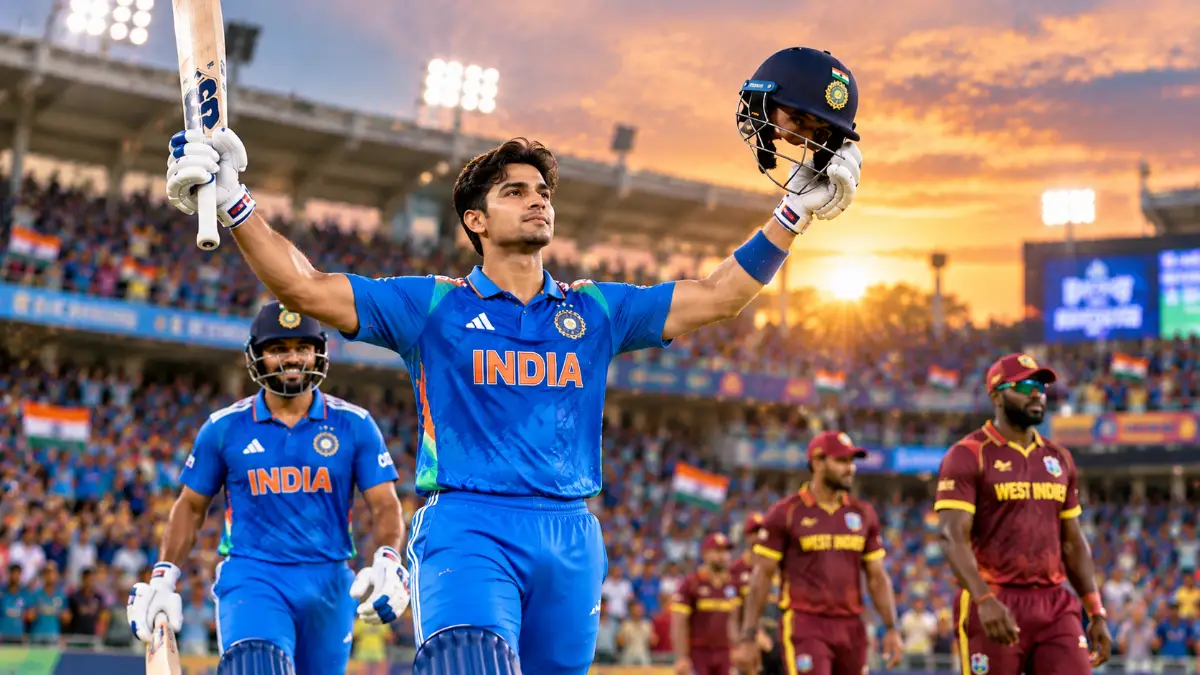
Who Won Yesterday’s Match: India vs West Indies India played against the West Indies in the second One Day International (ODI) match on 30 September 2026 at Barsapara Cricket Stadium, Guwahati – India won by eight wickets. The West Indies put on a score of 405/7, with the Indian team chasing the total in only 43.3 overs as captain Shubman Gill scored an impressive unbeaten 227 from 133 balls and Rohit Sharma made a century of his own, hitting 101.
To all U.S. readers who are not familiar with cricket, an ODI is a one-day international where both sides usually bat once or twice (depending on the format) to 50 overs each. With India’s successful chase, India now has a 2-0 lead in the five-match series and cannot be beaten.
| Question | Quick answer |
| Who won yesterday’s India vs West Indies match? | India |
| Match | 2nd ODI |
| Date | September 30, 2026 |
| Venue | Barsapara Cricket Stadium, Guwahati |
| West Indies score | 405/7 |
| India score | 406/2 in 43.3 overs |
| Result | India won by 8 wickets |
| Top scorer | Shubman Gill – 223* |
| Rohit Sharma | 101 |
| Series score | India led 2-0 |
India’s victory gave the hosts an unbeatable advantage in the three-match ODI series, with one game still to play.
Who Won Yesterday’s India vs West Indies Match?
2nd ODI: India beats West Indies by eight wickets. Having amassed 405/7 from their fifty overs, their highest total in men’s ODI cricket, it seemed that West Indies were well on course for victory.
But India went on to one of the greatest run-chases in the history of the game. Openers attacked from the start, with Shubman Gill hammering 206 off only 149 balls and Rohit Sharma scoring 100 in just103 balls to share a partnership of 255 for the first wicket as India ended at4122 in merely43.3 overs.
Gill ended the day not out at 223 while Rohit chipped in with 101, Virat Kohli added 29, and Ruturaj Gaikwad batted through with an unbeaten 30. India won with 6.3 overs to spare, taking a 2-0 lead in the series.
India vs West Indies Match at a Glance
| Match detail | Information |
| Match | India vs West Indies, 2nd ODI |
| Date | September 30, 2026 |
| Format | One Day International |
| Venue | Barsapara Cricket Stadium, Guwahati |
| West Indies | 405/7 in 50 overs |
| India | 406/2 in 43.3 overs |
| Winner | India |
| Winning margin | 8 wickets |
| Highest scorer | Shubman Gill – 223* |
| Series position | India led 2-0 |
India vs West Indies Full Score Summary
This was not a typical one-sided chase. West Indies produced their highest ODI total, had three individual centurions and crossed 400 for the first time in the format. India still won with more than six overs unused.
West Indies – 405/7
West Indies’ 405/7 was their highest score in men’s ODI cricket and the first time they had crossed 400.
John Campbell set the tone with 101, captain Shai Hope made 104, and Amir Jangoo top-scored with 114. It was the first time three West Indies batters had scored centuries in the same ODI innings. Their previous highest total was 389 against England in 2019.
Hope’s century was also his 20th in ODIs, taking him past Brian Lara on West Indies’ ODI century list. He moved behind only Chris Gayle among West Indies batters at that point.
India’s bowlers had a difficult day on a batting-friendly surface, but Kuldeep Yadav still finished with 2/65. Those wickets took him to 200 ODI wickets, making him the fastest Indian spinner to reach the landmark.
Why 405 Looked Like a Winning Score
A score above 400 is enormous in a 50-over game. To chase 406, India needed to average more than eight runs per over across the entire innings while also protecting their wickets.
That combination usually creates severe pressure. Losing two or three early wickets can make such a chase almost impossible because the required scoring rate continues to rise.
Instead, India did the opposite: the openers scored quickly while barely giving West Indies an opening.
India – 406/2 in 43.3 Overs
India’s response was extraordinary from the beginning.
Shubman Gill and Rohit Sharma built a huge first-wicket partnership before Rohit was dismissed for 101 from 75 balls. Gill continued attacking after Rohit’s departure and eventually finished on 223 not out from 133 deliveries.
Virat Kohli added 29 from 19 balls, while Ruturaj Gaikwad finished unbeaten on 30 from 36. India reached 406 with only two wickets down and 39 balls still available.
The fact that India lost only two wickets while chasing more than 400 was just as significant as the scoring rate. It meant Gill could continue attacking without the chase becoming desperate.
India vs West Indies Batting Comparison
| Team | Batter | Runs |
| West Indies | Amir Jangoo | 114 |
| West Indies | Shai Hope | 104 |
| West Indies | John Campbell | 101 |
| India | Shubman Gill | 223* |
| India | Rohit Sharma | 101 |
Five different batters scored centuries in the game, the first such instance in an ODI.
How Did India Chase 406?
India did not chase 406 through a late miracle. The foundation was built at the top of the innings, where Gill and Rohit prevented West Indies from creating early pressure.
Gill and Rohit’s 255-Run Opening Partnership
Gill and Rohit added 255 runs from 158 balls for the first wicket. By the time West Indies finally dismissed Rohit, more than 60% of the target had already been erased.
The partnership was important for two reasons.
First, the scoring rate stayed comfortably aligned with the required rate. India never reached a point where they needed an unrealistic late acceleration.
Second, the pair preserved wickets. Even after Rohit’s dismissal, India had virtually their entire middle order available.
Sky Sports reported that the 255-run stand was India’s second-highest opening partnership in ODI cricket, behind Sachin Tendulkar and Sourav Ganguly’s 258 against Kenya in 2001.
Rohit Sharma’s Century
Rohit Sharma scored 101 from 75 balls, bringing up his 35th ODI century.
His innings provided India with the aggressive start required to make a target of 406 realistic. Rohit reached his century from 72 balls before Jayden Seales dismissed him lbw.
During the innings, Rohit also passed 12,000 ODI runs. ICC reported that, at age 39, he became the oldest Indian batter to score an ODI century.
His role was especially valuable because Gill did not have to carry the required scoring rate alone during the first half of the chase.
Shubman Gill’s 223 Not Out
Gill produced the defining innings of the match.
The India captain reached his century in only 62 balls before accelerating further. He reached 200 in 117 balls, which the ICC reported was the fastest double century in ODI history, and eventually finished unbeaten on 223 from 133 deliveries.
The innings also became the highest individual score in a successful ODI run chase, surpassing Glenn Maxwell’s unbeaten 201 against Afghanistan at the 2023 World Cup.
Gill’s ability to stay until the finish was crucial. India did not simply get close to the target because of his innings-he remained at the crease until the record chase was completed.
Chase timeline:
Target 406 → Gill and Rohit add 255 → Rohit dismissed for 101 → Gill reaches 200 → India reaches 406/2 in 43.3 overs
Why Did West Indies Lose After Scoring 405?
West Indies did not lose because their batting total was poor. A score of 405/7 was the highest men’s ODI total in West Indies history. On most days, it would have created a strong position to win.
The bigger problem was their inability to stop India’s opening pair.
Gill and Rohit maintained the scoring rate from the beginning while giving West Indies almost no opportunity to expose India’s middle order. Their 255-run partnership transformed the chase from an intimidating 406-run target into a far more manageable equation.
India’s wickets in hand were another important factor. A team chasing at more than eight runs per over can quickly fall behind if several wickets go down. India lost only two wickets in the entire innings.
By the time Rohit was dismissed, the game had already shifted heavily toward India. Gill was set, the required rate remained under control, and India still had experienced batters available.
Three West Indies Centuries Were Still Not Enough
It is difficult to imagine a team having three centurions and still losing an ODI.
Campbell scored 101, Hope made 104, and Jangoo hit 114. Yet India responded with Rohit’s 101 and an innings more than twice as large from Gill.
Sky Sports noted that this was the first ODI in which five individual centuries were scored. It was also the first time a team with three individual centurions in an ODI innings ended up losing.
Turning Point of the Match
There was no single delivery that completely changed the contest.
The true turning point was India’s sustained opening partnership.
Every over that Gill and Rohit survived while maintaining the required scoring rate reduced West Indies’ advantage. Once the partnership crossed 200 without a wicket, the pressure increasingly shifted toward the bowlers.
Records Broken in India vs West Indies 2nd ODI
The match produced several major ODI records and milestones.
| Record | Achievement |
| India’s highest successful ODI chase | Target of 406 |
| West Indies’ highest men’s ODI total | 405/7 |
| Shubman Gill | 223* |
| Successful 400-plus ODI chases | India’s was only the second |
| Centuries in the match | Five |
| Kuldeep Yadav | Reached 200 ODI wickets |
| Gill’s double century | Reached in 117 balls |
| Rohit Sharma | Passed 12,000 ODI runs |
India’s chase was only the second successful chase of more than 400 in ODI history. South Africa’s famous 438/9 against Australia in Johannesburg in 2006 remains the other example.
India’s Previous Highest ODI Chase
Before this match, India’s highest successful ODI chase had come against Australia in Jaipur in 2013.
India were set 360 and reached 362/1, with Rohit Sharma, Shikhar Dhawan and Virat Kohli dominating the chase.
The 2026 performance against West Indies raised India’s successful-chase record significantly.
| Match | Target | Final score | Year |
| India vs West Indies | 406 | 406/2 | 2026 |
| India vs Australia | 360 | 362/1 | 2013 |
Who Was the Standout Player?
Shubman Gill was clearly the standout performer with the bat.
His unbeaten 223 accounted for more than half of India’s final total, but the importance of the innings went beyond the raw number.
Gill had to manage a target of 406, score quickly enough to prevent the required rate from climbing, build a massive partnership with Rohit and then continue after his opening partner was dismissed.
He also remained unbeaten until the chase was complete.
Along the way, Gill recorded the fastest ODI double century, the highest individual score in a successful ODI chase and the fastest ODI hundred by an Indian captain, reaching three figures from 62 balls.
What Does the Result Mean for the ODI Series?
India’s second ODI victory secured the three-match series with one game remaining.
India had already won the opening ODI in Thiruvananthapuram by eight wickets. West Indies scored 295/7 before India reached 300/2 in 41.4 overs.
Gill scored 110, while Virat Kohli produced an unbeaten 139 from 88 balls as India took a 1-0 lead.
The Guwahati victory therefore moved India to an unbeatable 2-0 advantage.
| Match | Winner | Series score after match |
| 1st ODI – Sept. 27 | India | India 1-0 |
| 2nd ODI – Sept. 30 | India | India 2-0 |
| 3rd ODI – Oct. 3 | Upcoming | – |
When Is the Next India vs West Indies Match?
The third and final ODI is scheduled for October 3, 2026, at the Maharaja Yadavindra Singh International Cricket Stadium in New Chandigarh, Punjab.
India have already secured the ODI series, so West Indies cannot level or win it. However, the third match still gives West Indies a chance to avoid a 3-0 sweep before the tour moves into a five-match T20I series beginning October 6.
Readers in the United States should check the official broadcast listing close to match day for the confirmed U.S. start time and streaming availability, as time-zone conversions vary across U.S. regions.
What Competitors Missed: The Match Explained for Readers Who Didn’t Watch
The scorecard tells you India won, but it does not fully explain why one of the biggest ODI totals ever chased suddenly became manageable.
How Could India Chase Such a Huge Score?
The key was combining a high scoring rate with wickets in hand.
India needed 406 from 300 legal deliveries. Gill and Rohit attacked immediately enough to stay close to the required pace, but they did so without losing early wickets.
Their 255-run opening stand meant India entered the final part of the chase with far fewer runs required and nearly an entire batting lineup still available.
That balance-fast scoring without frequent dismissals-is what separated India’s chase from a desperate slog.
Was 405 a Bad West Indies Batting Performance?
No.
West Indies’ 405/7 was their highest men’s ODI score ever, and three batters reached centuries. The batting innings was historically strong.
The result was instead driven by an even more extraordinary Indian batting performance and West Indies’ inability to break the opening partnership early enough.
Why Was Gill’s Innings More Important Than Just the 223 Runs?
Context matters.
Gill was not scoring 223 while setting a target with no immediate scoreboard pressure. He was chasing 406, meaning every quiet period could have pushed the required run rate higher.
He scored quickly, remained unbeaten, and finished the chase himself. His partnership with Rohit prevented early pressure, while his acceleration ensured India did not need a risky final-over finish.
What Should a Casual U.S. Sports Reader Know?
If you do not regularly follow cricket, these basics make the result easier to understand:
- An ODI gives each team up to 50 overs.
- An over normally contains six legal balls.
- The team batting second must exceed the first team’s total to win.
- A team can lose a maximum of 10 wickets before its innings ends.
- West Indies made 405, so India needed 406 to win.
- India reached 406 while losing only two wickets and using only 43.3 of their 50 overs.
In simple terms, India had both time and batting resources left when they completed an unusually difficult chase.
India vs West Indies 2nd ODI: Key Takeaways
- India won by eight wickets, reaching 406/2 in 43.3 overs.
- West Indies posted a national-record 405/7.
- Shubman Gill finished unbeaten on 223 from 133 balls.
- Rohit Sharma scored 101 from 75 balls.
- India completed their highest successful ODI chase and secured an unbeatable 2-0 series lead.
Conclusion
India won the September 30, 2026, second ODI against West Indies by eight wickets, but the result was far more remarkable than the winning margin suggests. West Indies had just produced their highest-ever men’s ODI total at 405/7, powered by three centuries, yet India chased 406 in only 43.3 overs.
Shubman Gill’s unbeaten 223 was the centerpiece, while Rohit Sharma’s century and their 255-run opening partnership turned an intimidating target into a historic victory.
India now lead the series 2-0. The next step for fans is the third ODI on October 3 in New Chandigarh, followed by the five-match T20I series.
Frequently Asked Questions
India vs West Indies last match result yesterday?
Also read: India chase down mammoth target with ease, beat West Indies in 2nd ODI (Sep 26, 2026). Economically restricting their calypso counterparts to barely over.
You were late for the final score of india vs west indies 2022 yesterday
GUGFIRE: West Indies | 409/3 (50 Overs) India chased this mammoth first innings total of 409, scoring a gallant 406 in the battle against direction-altering conditions by losing just two wickets, with the remarkable believability of winning by eight wickets during Saturday’s game on October seventh.
IND 108/2, WI 105 (17.5 ov); India won by 8 wickets
After being set 406 runs in the chase, India registered a convincing victory, losing only the wickets of Wriddhiman Saha, Rohit Sharma and Virat Kohli.
Shubman Gill’s runs (l-r) against West Indies
Shubman Gill was on 223 (the runs came off133 balls). In just 117 balls, to become joint fastest ODI double century.
It was Who v/s – West Indies vs Rohit Sharma (HUNDRED)
Yes. Rohit had made 101 off 75 balls while sharing a325-run opening partnership with Shubman Gill. It was Rohit’s 35th ODI century in his career.
Hardik Pandya: Which West Indies player scored the centuries in those conditions?
John Campbell 101, Shai Hope 104 & Amir Jangoo 114 were the scorers in the three games. There was an ODI first *First such loss by a team with three centuries (Sri Lanka’s 3-centurion innings v Australia in 2018 remains the only other to be scoreless centurions – though Sri Lanka were the first side ever to score without individual hundreds against Australia, which later achieved another feat against West Indies).
406 is also the highest score chased down by India in an ODI as well.
Yes. The match was also India’s highest-ever ODI run chase, achieving 406. India’s previous highest was chasing down the 360 scored against Australia at Sawai Mansingh Stadium in Jaipur way back in November 2013, when India posted a score of 362/1
Number of hundreds in India vs WI
Five centuries were scored. West Indies 100-00: Campbell, Hope & Jangoo make Rams India In Response Kohli First Ball Four flush but does not score Hundred || Rohit Sharma Shubman Gill how | To do It also the first time five batsmen scored tons in One ODI.
They have a tour lineup with a white-ball and Test series starting in August 2023: India v West Indies (ODI series).
India have sealed the series 2-0 in a 3-match ODI series. They brushed aside their neighbours easily, winning both ODIs by some distance – eight wickets in each match.
Next Match: India vs West Indies (Tournament)
3rd ODI: 03 Oct, 2026 – Maharaja Yadavindra Singh International Cricket Stadium, New Chandigarh, Punjab
