

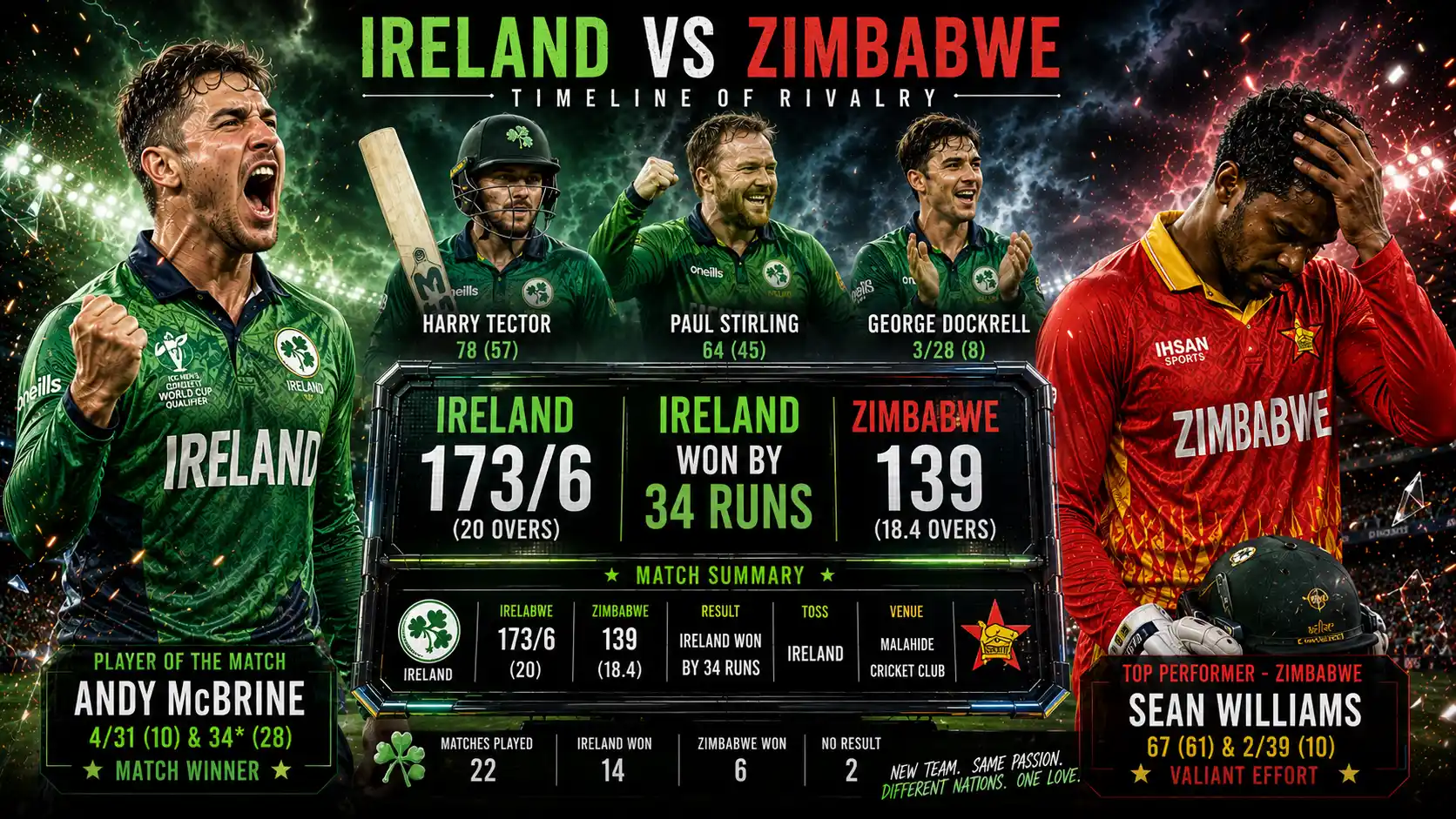
Ireland lead the ODI head-to-head 11 wins to 10 from 25 matches, while the T20I record is dead level at 8 wins apiece from 18 matches, making this one of the most evenly balanced bilateral rivalries between a Test nation and a former associate side.
The Ireland Cricket Team vs Zimbabwe National Cricket Team Timeline highlights a level of statistical parity that is unusual in international cricket. Most contests between a longer-established Full Member nation like Zimbabwe and a newer Test-status country like Ireland tend to skew heavily in favour of the more experienced side. That hasn’t happened here, and the reasons behind this remarkable balance form the backbone of this entire timeline.
ODI Record Breakdown
Ireland’s ODI advantage has been built almost entirely on home soil, where their seam-heavy attacks exploit English-style conditions that Zimbabwe’s batters find harder to adjust to on short tours. Of the three matches that didn’t produce a clear winner, three ended in no result, and one finished as a tie, a rare outcome that still gets referenced whenever these two sides meet in bilateral cricket previews.
T20I Record Breakdown
The T20I ledger tells a different story. Because the shortest format compresses margins for error, Zimbabwe’s explosive top-order hitters have consistently kept pace with Ireland regardless of venue, producing a genuinely 50-50 rivalry in this format. Two matches ended without a result, both due to weather interruptions that have become a recurring theme whenever these teams tour each other’s countries.
Why This Rivalry Carries Extra Weight
The Ireland-Zimbabwe rivalry matters because it represents a direct competition between an established Full Member nation and a rapidly rising Test-status side fighting for the same tier of world cricket relevance.
Zimbabwe has held Test status since 1992 and carries decades of institutional cricket history, including multiple ICC Cricket World Cup appearances and a golden generation in the early 2000s built around players like Andy Flower. Ireland, by contrast, spent most of its cricketing existence as an associate nation before finally earning full Test status in 2017, arriving on the international stage through shock wins over Full Members at global tournaments rather than gradual institutional growth.
Two Different Paths to Relevance
Zimbabwe’s cricketing identity has always been tied to conditions mastery – spin-friendly, slow pitches in Harare and Bulawayo that reward local knowledge over raw pace. Ireland’s rise, meanwhile, has been powered by disciplined seam bowling and a batting unit that thrives in cooler, seam-friendly conditions back home. When these two contrasting cricketing philosophies collide, the results tend to hinge heavily on where the match is being played, a pattern that repeats across nearly every series in this timeline.
A Rivalry Shaped by Global Qualification Stakes
Beyond bilateral pride, both boards have used this fixture to prepare for ICC World Cup Qualifiers and T20 World Cup campaigns, meaning almost every series carries an added layer of tournament rehearsal. This context explains why both sides have historically fielded near-full-strength squads for what might otherwise look like a routine bilateral assignment.
Early Era (2010-2016): Zimbabwe’s Home Fortress
Zimbabwe won both ODI series played against Ireland during this period, taking the 2010/11 and 2015/16 series 2-1 each on home soil.
Ireland’s early tours to Zimbabwe exposed a genuine gap in away-form resilience. Playing on slow, low-bouncing Harare and Bulawayo pitches, Ireland’s batting order – still developing depth compared to Full Member nations – struggled to build the same partnerships they managed at home. Zimbabwe’s senior core exploited this unfamiliarity by grinding out totals through the middle overs rather than relying on explosive strokeplay.
The 2010/11 Series
Zimbabwe’s spin attack dominated the middle overs throughout this series, restricting Ireland’s scoring rate in a way that would define the early years of this rivalry. Ireland’s inexperience against turning tracks proved costly, and the hosts closed out the series 2-1.
The 2015/16 Series
A near-identical pattern emerged five years later. Zimbabwe again used home conditions to their advantage, with their top order building long, patient innings that Ireland’s bowling attack – still without the depth it would later develop – couldn’t consistently break down. The series finished 2-1 once more, cementing Zimbabwe’s reputation as the senior partner in this fixture at that stage.
2019: Ireland’s First Real Statement
Ireland swept Zimbabwe 3-0 in the 2019 home ODI series, their first-ever clean sweep against the Zimbabweans, while the accompanying T20I series finished level at 1-1.
This series marks the genuine turning point in the Ireland Cricket Team vs Zimbabwe National Cricket Team Timeline. Played on home surfaces in Dublin and Bready, Ireland’s fast bowlers dismantled Zimbabwe’s top order across all three matches, showcasing a level of pace and seam discipline the visitors simply couldn’t handle.
Why the ODI Sweep Mattered
This wasn’t just a home-conditions win – it signalled that Ireland’s investment in fast-bowling depth over the preceding years had genuinely closed the gap with a Full Member side. Mark Adair and Barry McCarthy led a seam attack that consistently found movement off the pitch, a stark contrast to the spin-dominated contests of the previous decade.
The T20I Split
Zimbabwe steadied themselves considerably in the shorter format, splitting the T20I series 1-1. This became a recurring theme throughout the rivalry: Ireland dominant in 50-over cricket at home, Zimbabwe far more competitive once the format shrinks to 20 overs.
2021 Series: Margins Get Tighter
Ireland extended their home dominance in 2021, but the results carried a warning sign for the future. The T20I series finished 3-2 in Ireland’s favour, while the ODI series ended level at 1-1, both played across Dublin and Bready.
Read more: Ireland Cricket Team vs Zimbabwe National Cricket Team Timeline
Zimbabwe’s Adaptation
The narrower 3-2 T20I margin revealed that Zimbabwe’s aggressive top-order batters were adjusting to Irish conditions faster than expected. What could easily have become another routine Ireland sweep instead turned into a genuinely tight contest decided by fine margins in the death overs, suggesting Zimbabwe’s white-ball approach was maturing quickly.
2022/23: Zimbabwe Regroups on Home Turf
Zimbabwe won the 2022/23 T20I series 2-1 on home soil, while the ODI series that accompanied it finished level at 1-1.
Back in familiar Harare conditions, Zimbabwe’s spinners reasserted control over match tempo, returning to the same slow-turning pitches that had troubled Ireland a decade earlier. This series also carried extra significance as preparation for the 2023 ODI World Cup Qualifier, meaning both boards treated bilateral results as genuine form indicators heading into a tournament both nations desperately wanted to reach.
Tactical Adjustments From Zimbabwe
Zimbabwe’s captaincy leaned heavily on spin-friendly field placements – tight ring fields designed to choke scoring rather than attack wickets directly, forcing Ireland’s batters into risky shots against turn. This approach worked well enough to reclaim home advantage in the shortest format.
2023/24: Ireland’s Away Breakthrough
Ireland finally solved their long-standing away-form problem in 2023/24, winning the T20I series 2-1 and sweeping the ODI series 2-0, both played in Zimbabwe.
This is arguably the single most important series in the entire Ireland Cricket Team vs Zimbabwe National Cricket Team Timeline, because it marked Ireland’s first away ODI series win against Zimbabwe since the rivalry began. The turning point was purely tactical: rather than trying to out-spin Zimbabwe on their own pitches, Ireland’s seamers targeted relentless stump-to-stump lines, denying the width that Zimbabwe’s batters typically thrive on.
A Captaincy Shift That Paid Off
Ireland’s leadership group made a deliberate decision to prioritise disciplined seam bowling over experimenting with spin options, even on tracks that traditionally favoured turn. This adjustment paid immediate dividends across both formats, proving that Ireland’s bowling depth had matured enough to succeed away from home rather than just in favourable domestic conditions.
February 2025: The All-Format Tour That Defined the Rivalry
Ireland won the one-off Test by 63 runs in Bulawayo, Zimbabwe won the ODI series 2-1, and the T20I series produced no clear winner after two of three matches were washed out by rain.
This seven-match, three-format tour became the most complete examination of both squads’ depth in the entire rivalry, packed into a single month.
The Historic Test Win
Ireland’s 63-run victory in Bulawayo was only their sixth Test match overall, making the result especially significant given how rarely Ireland gets Test opportunities compared to Full Member nations. The win showcased genuine top-order resilience against Zimbabwe’s most experienced bowling attack, a rare marker of red-ball progress for a side still building Test-match depth.
The ODI Series Swing
Zimbabwe responded emphatically in the 50-over leg. A 49-run win in the series opener was followed by an Ireland win in the middle match, before Zimbabwe closed out the series with a commanding nine-wicket victory in the decider. The 2-1 result reversed Ireland’s away breakthrough from the previous year, showing just how quickly momentum can shift in this rivalry.
A T20I Series That Never Found Its Rhythm
Persistent rain wiped out the first and third T20Is entirely, leaving Zimbabwe’s solitary three-wicket win in the second match as the only completed contest of the series. Neither side could make a definitive statement in the shortest format, an outcome that left both camps wanting more heading into 2026.
The 2026 T20 World Cup Meeting
Ireland and Zimbabwe’s scheduled Group B clash at the ICC Men’s T20 World Cup on 17 February 2026 was abandoned before a toss could take place, with both sides awarded one point each.
After more than a decade of tightly contested bilateral cricket, the two nations’ first meeting at a T20 World Cup since 2014 ended in complete anticlimax. Weather conditions prevented any play, and the shared point carried real weight for both sides’ Super 12 qualification hopes at the time, even though not a single ball was bowled.
Complete Format-Wise Head-to-Head Table
| Format | Total Matches | Ireland Wins | Zimbabwe Wins | Other Results |
| ODI | 25 | 11 | 10 | 3 no result, 1 tie |
| T20I | 18 | 8 | 8 | 2 no result |
| Test | 1 | 1 | 0 | – |
Tactical Patterns Across the Rivalry
Looking across the full sixteen-year span of this Ireland Cricket Team vs Zimbabwe National Cricket Team Timeline, a few clear patterns emerge that explain why the head-to-head record remains so tightly balanced.
Home Advantage Decides ODIs
Nearly every ODI series in this rivalry has been shaped by conditions rather than raw squad quality. Ireland’s seam-friendly home tracks favour disciplined fast bowling, while Zimbabwe’s slower Harare and Bulawayo surfaces reward patient batting and spin control. Whichever side is hosting typically enters as the favourite, regardless of recent form.
T20Is Remain Genuinely Unpredictable
Unlike the ODI format, T20I results have shown almost no home-ground bias, staying locked at 8-8 across 18 matches. This suggests that both nations have developed comparable white-ball hitting depth, even if their overall board resources differ significantly.
Bowling Depth Has Been the Real Difference-Maker
Every major shift in the rivalry – Ireland’s 2019 breakthrough, their 2023/24 away sweep, Zimbabwe’s 2025 ODI response – has been driven primarily by bowling tactics rather than batting fireworks. Captains on both sides have repeatedly won series by adjusting bowling plans to conditions rather than simply picking their strongest batting line-up.
What’s Next for This Rivalry
With Ireland’s 2026 home international summer already confirmed to include fixtures against major cricketing nations, and Zimbabwe continuing to build toward future ICC qualification cycles, this rivalry shows no signs of settling into a predictable pattern. If history is any guide, whichever side hosts the next bilateral series will enter as the favourite in ODIs, while the T20I result remains genuinely impossible to predict.
Frequently Asked Questions
What is the overall head-to-head record between Ireland and Zimbabwe in cricket?
Ireland lead 11-10 in ODIs from 25 matches, and the two sides are tied 8-8 in T20Is from 18 matches, making this one of the most balanced rivalries in international cricket.
When did Ireland first defeat Zimbabwe in Test cricket?
Ireland recorded their first-ever Test win over Zimbabwe in February 2025, winning by 63 runs in Bulawayo – only their sixth Test match overall.
What happened during the Ireland vs Zimbabwe match at the 2026 T20 World Cup?
The scheduled Group B fixture on 17 February 2026 was abandoned before a toss could occur, and both teams were awarded one point each.
Has Zimbabwe ever won an ODI series against Ireland by a clean sweep?
No, Zimbabwe’s largest series wins against Ireland have been 2-1 margins, most notably in 2010/11, 2015/16, and again in the 2025 ODI leg of their all-format tour.
What was Ireland’s biggest series victory over Zimbabwe?
Ireland’s 3-0 ODI sweep at home in 2019 remains their most dominant result against Zimbabwe in this rivalry.
Why does Ireland perform better at home than in away ODIs against Zimbabwe?
Ireland’s home pitches favour seam and pace bowling, which suits their squad’s strengths, while Zimbabwe’s home surfaces are slower and reward spin and patient batting.
How many times have Ireland and Zimbabwe played each other in T20I cricket?
The two nations have met 18 times in T20I cricket, with 8 wins apiece and 2 matches ending without a result.
What made the February 2025 tour significant in this rivalry?
It was a rare all-format tour featuring a Test, three ODIs, and three T20Is in a single month, giving both squads a complete test of depth across formats.
Did rain affect any major series in the Ireland vs Zimbabwe rivalry?
Yes, the T20I leg of the February 2025 tour saw two of three matches abandoned due to rain, leaving the series without a clear result.
What are Ireland’s upcoming home fixtures relevant to this rivalry’s context?
Ireland’s 2026 home international summer includes matches against several major cricketing nations, continuing their push to build depth across all formats heading into future qualification cycles.
