

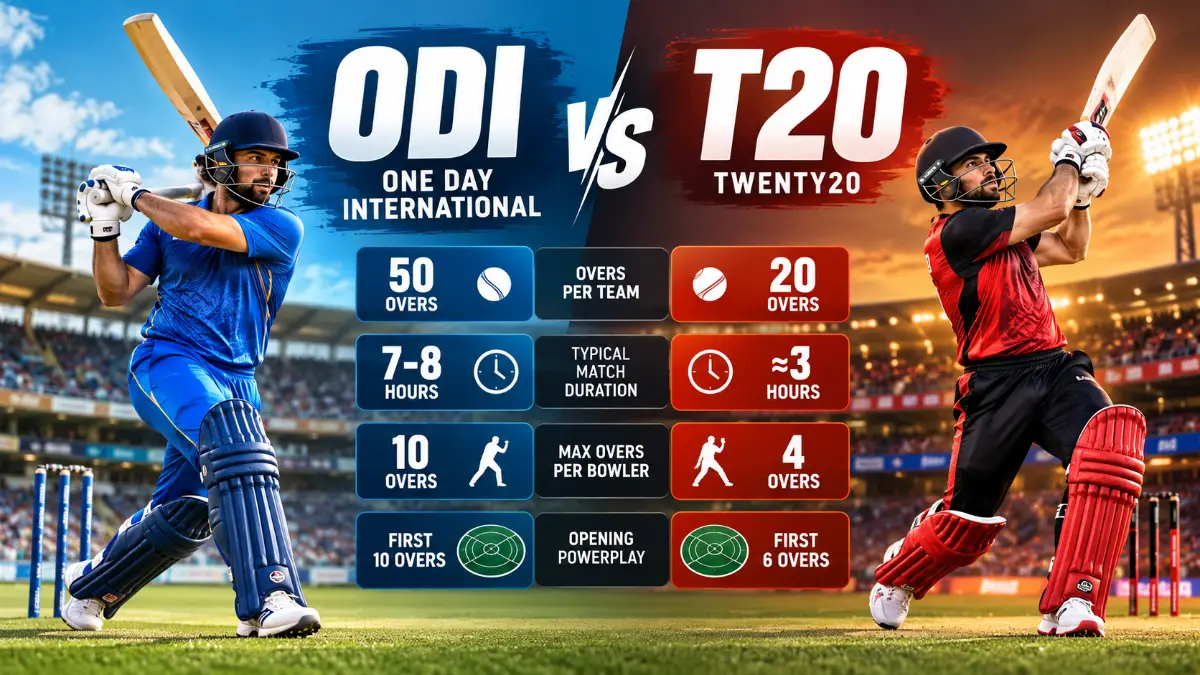
The main difference between ODI and T20 cricket is the number of overs each team can play. One Day International (ODI) matches allow up to 50 overs per team, while Twenty20 (T20) matches allow 20. An ODI typically lasts 7-8 hours, compared with approximately three hours for a T20 match. The longer ODI format gives teams more time to build an innings, whereas T20 cricket generally encourages aggressive batting and quicker scoring.
Both formats follow the same basic cricket laws, including batting, bowling, fielding, and dismissals. However, they differ in powerplays, bowling limits, match duration, and playing strategies. According to the International Cricket Council’s explanation of cricket formats, ODI and T20 International (T20I) are two distinct forms of international limited-overs cricket. T20 also includes domestic and franchise competitions, while T20I specifically refers to qualifying international matches between national teams.
ODI vs T20 Cricket: Key Differences at a Glance
The following table compares the main features of standard men’s ODI and T20 International matches.
| Feature | ODI Cricket | T20 Cricket |
| Full form | One Day International | Twenty20 |
| Overs per team | 50 | 20 |
| Maximum legal deliveries | 300 | 120 |
| Innings per team | 1 | 1 |
| Typical match duration | 7-8 hours | Around 3 hours |
| Maximum overs per bowler | 10 | 4 |
| Opening powerplay | First 10 overs | First 6 overs |
| Fielders allowed outside the circle during opening powerplay | 2 | 2 |
| Batting approach | Balanced and strategic | Generally aggressive |
| Scoring pattern | Runs accumulated over a longer innings | Faster scoring generally emphasized |
| Major international tournament | ICC Cricket World Cup | ICC T20 World Cup |
These figures apply to standard matches. Rain delays, reduced overs, and competition-specific playing conditions can affect the number of overs and certain restrictions.
How Are ODI and T20 Rules Different?
ODI and T20 cricket share the same basic laws, but their playing conditions influence how teams manage batting, bowling, and field placements.
Overs, Innings, and Bowling Limits
An over consists of six legal deliveries from one bowler. Wides and no-balls do not normally count toward those six deliveries, although they add extra runs to the batting team’s score. This distinction is covered in the official MCC Laws of Cricket.
In an ODI, each team can face a maximum of 300 legal deliveries across 50 overs. A T20 innings contains up to 120 legal deliveries across 20 overs.
Both formats give each team one innings. An innings can end early if the batting team loses ten wickets or if the team batting second reaches its target before using all its overs.
The bowling limits are different:
- ODI: A bowler can bowl a maximum of 10 overs in a full 50-over innings.
- T20: A bowler can bowl a maximum of four overs in a full 20-over innings.
These restrictions mean captains must distribute overs among several bowlers rather than depending heavily on one or two players.
When rain or other interruptions reduce the length of an innings, bowling allowances are adjusted under the applicable playing conditions.
ODI vs T20 Powerplay Rules
A powerplay restricts how many fielders can stand outside the 30-yard circle, creating more opportunities for batters to find gaps in the field.
In standard men’s ODI cricket, fielding restrictions change across three phases:
| ODI Overs | Maximum Fielders Outside 30-Yard Circle |
| 1-10 | 2 |
| 11-40 | 4 |
| 41-50 | 5 |
During the first ten overs, only two fielders may be positioned outside the circle. The limit increases to four during the middle overs and five during the final ten overs.
In men’s T20 International cricket, the opening powerplay lasts just six overs. Only two fielders can stand outside the circle during this period. From the seventh over onward, a maximum of five fielders are normally allowed outside.
The shorter powerplay gives T20 batters a limited window to take advantage of fielding restrictions. ODI teams, meanwhile, can spread their attacking approach across a longer innings.
These are the standard men’s international restrictions outlined in the ICC ODI and T20I playing conditions. Women’s competitions and certain domestic tournaments may have different requirements.
How Do Batting, Scoring, and Strategies Differ?
The number of available deliveries changes how teams approach almost every stage of a match. ODI cricket offers more opportunities to recover from early wickets, while T20 leaves less room for a slow start.
Batting Approach and Strike Rate
ODI batters usually balance attacking shots with protecting their wickets. With 50 overs available, teams can build partnerships, rotate the strike, and gradually increase their scoring rate.
In T20 cricket, batters have fewer deliveries to make an impact. They often look for boundaries earlier and take greater risks to maintain momentum.
A batter’s strike rate measures how many runs they score per 100 balls faced.
For example:
- A batter scoring 60 runs from 60 balls has a strike rate of 100.
- A batter scoring 60 runs from 30 balls has a strike rate of 200.
The second batter scores at twice the rate, but that does not automatically make the innings more valuable. Match conditions, wickets remaining, and the required scoring rate all affect how useful a performance is.
ODI batters often need to change gears throughout an innings. T20 batters generally have less time to settle before accelerating.
Run Rate and Scoring Examples
Run rate tells you how quickly a team scores by measuring its average runs per over.
Run Rate = Total Runs ÷ Overs Faced
Consider these hypothetical scores:
| Format | Runs Scored | Overs | Run Rate |
| ODI | 250 | 50 | 5.00 |
| T20 | 160 | 20 | 8.00 |
The ODI team scores more runs overall, but the T20 team scores at a faster rate.
This is a useful way to compare scoring patterns, although actual totals vary considerably. Pitch conditions, weather, batting strength, and bowling quality all influence how many runs a team can make.
Bowling and Fielding Strategies
ODI bowlers must manage their spells across a longer match. Captains can rotate fast bowlers and spinners, save overs for serious situations, and adjust field placements as the innings develops.
T20 bowling places greater pressure on every delivery. Bowlers often use yorkers, slower balls, and variations in pace to make aggressive batting more difficult.
Fielding matters in both formats. A quick stop near the boundary, a direct-hit run-out, or a difficult catch can shift momentum. In T20 matches, where teams have fewer deliveries to recover, those moments can be particularly costly.
ODI World Cup vs T20 World Cup
The ICC Cricket World Cup and ICC T20 World Cup are major international tournaments, but they use different formats.
The ICC Cricket World Cup is played in the 50-over ODI format. Its longer matches require teams to manage wickets, scoring opportunities, and bowling resources throughout the innings. The ICC Men’s Cricket World Cup format also determines how teams progress through the competition.
The ICC T20 World Cup features 20-over international matches. With fewer balls available, teams often emphasize attacking batting, effective death bowling, and quick tactical decisions. The ICC Men’s T20 World Cup competition format determines how participating nations advance through the tournament.
Franchise competitions are another important distinction.
The Indian Premier League (IPL), for example, follows the T20 format, but IPL games are not classified as T20 Internationals. T20I status applies to qualifying international matches between national teams, not domestic franchise fixtures.
Frequently Asked Questions
What is the main difference between ODI and T20 cricket?
The main difference is the number of overs. ODI cricket allows 50 overs per team, while T20 cricket allows 20 overs. ODI matches typically last 7–8 hours, whereas T20 matches usually take around three hours.
Which is better, ODI or T20 cricket?
Neither format is objectively better. ODI cricket emphasizes patience, partnerships, and long-term strategy, while T20 focuses on aggressive batting, faster scoring, and quick decisions. The better format depends on what viewers enjoy.
What is the difference between ODI and T20 powerplay rules?
In men’s ODI cricket, the first powerplay lasts 10 overs, with only two fielders allowed outside the 30-yard circle. In men’s T20 Internationals, the opening powerplay lasts six overs with the same two-fielder restriction.
How many overs can a bowler bowl in ODI and T20?
In a standard ODI match, one bowler can bowl a maximum of 10 overs. In a standard T20 match, the limit is four overs. These limits may be reduced when matches are shortened.
