

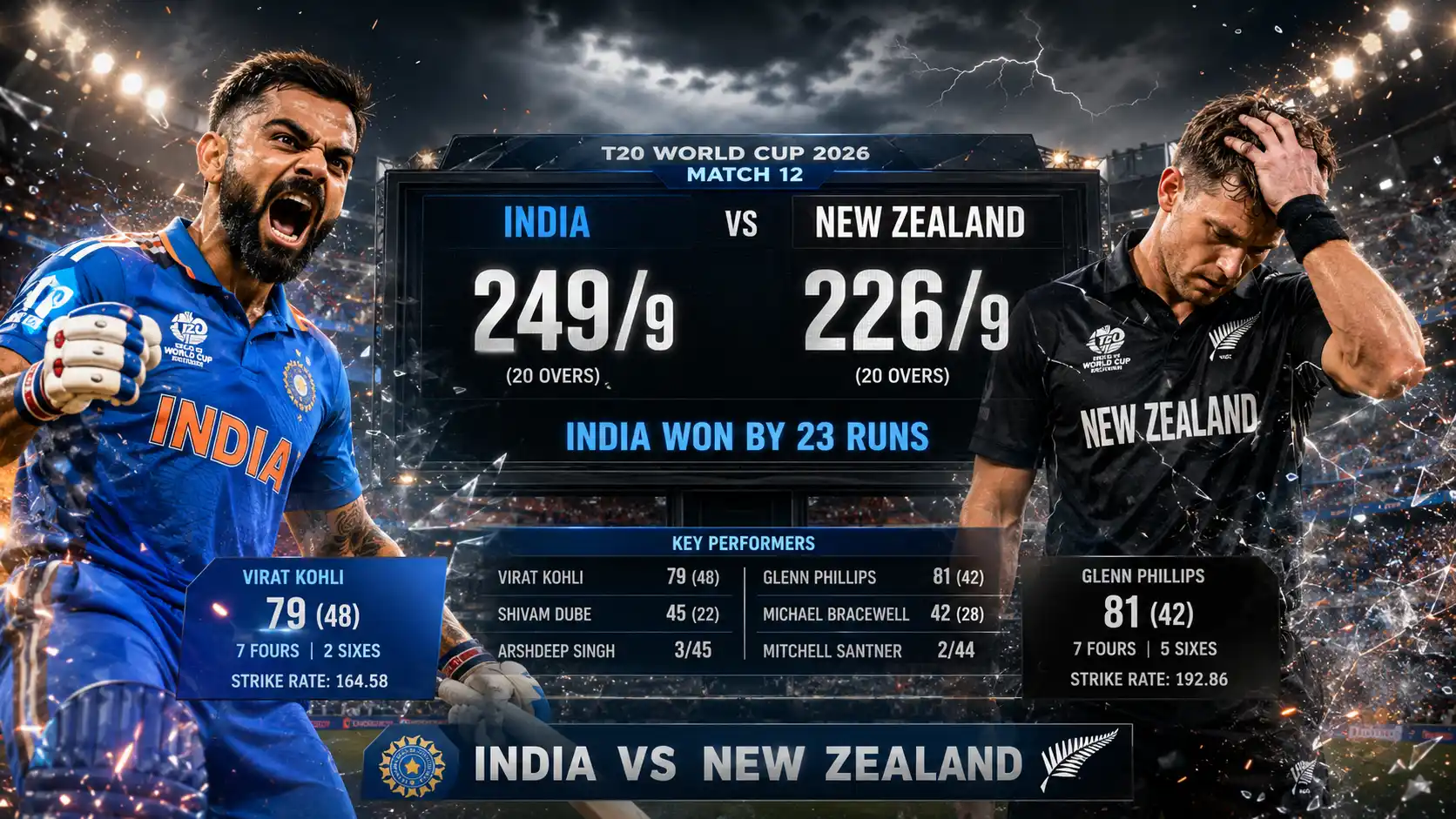
The India National Cricket Team vs New Zealand National Cricket Team Match Scorecard from the 2026 T20 World Cup final tells one of the most emphatic stories in tournament history: India posted 255/5, New Zealand were bowled out for 159, and the Men in Blue lifted their third T20 World Cup title with a 96-run margin. This full match scorecard breaks down every innings, every bowling spell, and every turning point that decided the contest.
Match Summary and Quick Result
India defeated New Zealand by 96 runs in the ICC Men’s T20 World Cup 2026 final, played on March 8, 2026, at Narendra Modi Stadium, Ahmedabad. India scored 255/5 in 20 overs, and New Zealand were dismissed for 159 in 19 overs, with Jasprit Bumrah named Player of the Match for his 4/15.
This scoreline made it the highest total ever recorded in a T20 World Cup final, and it confirmed India as the first team to win three world titles in the format. Anyone searching the India national cricket team vs New Zealand national cricket team match scorecard for this fixture will find a result that was decisive well before the chase even reached its halfway point.
Match Details at a Glance
| Detail | Information |
| Match | Final, ICC Men’s T20 World Cup 2026 |
| Date | March 8, 2026 |
| Venue | Narendra Modi Stadium, Ahmedabad |
| Toss | New Zealand won, elected to field |
| Result | India won by 96 runs |
| Player of the Match | Jasprit Bumrah |
| Attendance | 86,824 |
Playing XIs for Both National Cricket Teams
India fielded an unchanged XI, while New Zealand made one change, bringing in seamer Jacob Duffy for spinner Cole McConchie.
The stability in India’s lineup reflected confidence built through the tournament, whereas New Zealand’s tactical shift signaled an attempt to add extra pace firepower against India’s explosive top order.
India Playing XI
- Sanju Samson (wicketkeeper)
- Abhishek Sharma
- Ishan Kishan
- Suryakumar Yadav (captain)
- Tilak Varma
- Shivam Dube
- Hardik Pandya
- Axar Patel
- Arshdeep Singh
- Varun Chakravarthy
- Jasprit Bumrah
New Zealand Playing XI
- Finn Allen
- Tim Seifert (wicketkeeper)
- Rachin Ravindra
- Glenn Phillips
- Mark Chapman
- Daryl Mitchell
- Mitchell Santner (captain)
- James Neesham
- Matt Henry
- Lockie Ferguson
- Jacob Duffy
India Batting Scorecard: 255/5 in 20 Overs
India’s batting scorecard was built on a 98-run powerplay stand between Sanju Samson and Abhishek Sharma, followed by a middle-order collapse that Shivam Dube’s late blitz repaired.
This phase-by-phase breakdown shows exactly how India reached their highest-ever T20 World Cup final total, and why the innings almost stumbled before recovering hard in the death overs.
| Batter | Dismissal | Runs | Balls | 4s | 6s | SR |
| Sanju Samson | c sub b Neesham | 89 | 46 | 5 | 8 | 193.47 |
| Abhishek Sharma | c Seifert b Ravindra | 52 | 21 | 6 | 3 | 247.62 |
| Ishan Kishan | c Chapman b Neesham | 54 | 25 | 4 | 4 | 216.00 |
| Hardik Pandya | c Santner b Henry | 18 | 13 | 1 | 1 | 138.46 |
| Suryakumar Yadav (c) | c Ravindra b Neesham | 0 | 1 | 0 | 0 | 0.00 |
| Tilak Varma | not out | 8 | 6 | 0 | 0 | 133.33 |
| Shivam Dube | not out | 26 | 8 | 3 | 2 | 325.00 |
| Extras | (w 8) | 8 | ||||
| Total | 5 wickets, 20 overs | 255 | 19 | 18 | RR: 12.75 |
Fall of Wickets – India Innings
1/98 (Abhishek Sharma, 7.1 ov), 2/203 (Samson, 15.1 ov), 3/204 (Kishan, 15.5 ov), 4/204 (Yadav, 15.6 ov), 5/226 (Pandya, 18.2 ov).
The jump from 98/0 to 203/1 shows how fast the second-wicket stand between Samson and Kishan accelerated the total, while three wickets falling inside two balls (15.1 to 15.6 overs) reveals just how sharply momentum can swing even in a dominant innings.
New Zealand Bowling Card
James Neesham was New Zealand’s most impactful bowler with 3/46, dismissing three India batters inside a single over, but his effort couldn’t stop India from crossing 255.
| Bowler | Overs | Runs | Wickets | Economy |
| Matt Henry | 4 | 49 | 1 | 12.25 |
| Glenn Phillips | 1 | 5 | 0 | 5.00 |
| Jacob Duffy | 3 | 42 | 0 | 14.00 |
| Lockie Ferguson | 2 | 48 | 0 | 24.00 |
| Mitchell Santner | 4 | 33 | 0 | 8.25 |
| Rachin Ravindra | 2 | 32 | 1 | 16.00 |
| James Neesham | 4 | 46 | 3 | 11.50 |
Neesham’s triple-strike over briefly threatened to derail India’s momentum, but the lack of support from Ferguson and Duffy – both conceding over 14 runs per over – meant the damage never compounded into a genuinely competitive total-limiting effort.
Read more: India National Cricket Team vs New Zealand National Cricket Team Match Scorecard
New Zealand Batting Scorecard: 159 All Out in 19 Overs
New Zealand’s chase collapsed to 72/5 within nine overs, and despite fighting knocks from Tim Seifert and Mitchell Santner, the required run rate climbed beyond recovery.
This innings-by-innings collapse is central to understanding why the India national cricket team vs New Zealand national cricket team match scorecard ended in such a lopsided margin, despite New Zealand’s reputation as a resilient knockout side.
| Batter | Dismissal | Runs | Balls | 4s | 6s | SR |
| Tim Seifert | c Kishan b Chakravarthy | 52 | 26 | 2 | 5 | 200.00 |
| Finn Allen | c Tilak b Patel | 9 | 7 | 1 | 0 | 128.57 |
| Rachin Ravindra | c Kishan b Bumrah | 1 | 2 | 0 | 0 | 50.00 |
| Glenn Phillips | b Patel | 5 | 5 | 1 | 0 | 100.00 |
| Mark Chapman | b Pandya | 3 | 8 | 0 | 0 | 37.50 |
| Daryl Mitchell | c Kishan b Patel | 17 | 11 | 0 | 2 | 154.54 |
| Mitchell Santner (c) | b Bumrah | 43 | 35 | 3 | 2 | 123.00 |
| James Neesham | b Bumrah | 8 | 7 | 1 | 0 | 114.28 |
| Matt Henry | b Bumrah | 0 | 1 | 0 | 0 | 0.00 |
| Lockie Ferguson | not out | 6 | 7 | 0 | 0 | 85.71 |
| Jacob Duffy | c Tilak b Abhishek | 3 | 5 | 0 | 0 | 60.00 |
| Extras | (b 4, lb 1, w 7) | 12 | ||||
| Total | All out, 19 overs | 159 | 8 | 9 | RR: 8.36 |
Fall of Wickets – New Zealand Innings
1/31 (Allen, 2.4 ov), 2/32 (Ravindra, 3.1 ov), 3/48 (Phillips, 4.5 ov), 4/70 (Chapman, 7.4 ov), 5/72 (Seifert, 8.1 ov), 6/124 (Mitchell, 12.5 ov), 7/141 (Neesham, 15.3 ov), 8/141 (Henry, 15.4 ov), 9/152 (Santner, 17.3 ov), 10/159 (Duffy, 18.6 ov).
Losing five wickets for 72 runs inside the first nine overs effectively ended New Zealand’s chase before it began, and the required run rate exceeding 13 runs per over by the halfway mark made a comeback statistically improbable against a bowling attack led by Bumrah.
India Bowling Card
Jasprit Bumrah’s 4/15 in 4 overs was the standout spell of the final, combining wicket-taking with a suffocating economy rate of 3.75.
| Bowler | Overs | Runs | Wickets | Economy |
| Arshdeep Singh | 4 | 32 | 0 | 8.00 |
| Hardik Pandya | 4 | 36 | 1 | 9.00 |
| Axar Patel | 3 | 27 | 3 | 9.00 |
| Jasprit Bumrah | 4 | 15 | 4 | 3.75 |
| Varun Chakravarthy | 3 | 39 | 1 | 13.00 |
| Abhishek Sharma | 1 | 5 | 1 | 5.00 |
Bumrah’s economy of 3.75 wasn’t just about the four wickets – every dot ball he bowled inflated New Zealand’s required run rate at the other end, applying compounding pressure that Axar Patel’s 3/27 then converted into a full collapse.
Why India Won: Phase-by-Phase Analysis
India dominated all three phases of the innings – the powerplay, middle overs, and death overs – while New Zealand never recovered from an early batting collapse against India’s seam and spin combination.
Powerplay Breakdown (Overs 1-6)
Samson and Sharma’s 98-run opening stand inside seven overs was the fastest start of any T20 World Cup final innings, immediately forcing New Zealand’s captain into defensive field placements far earlier than any knockout script usually allows.
Middle Overs Breakdown (Overs 7-16)
Ishan Kishan’s rapid fifty extended the pressure, though Neesham’s triple-wicket over stands out as New Zealand’s only real sliding door moment – India still finished this phase well past the 200-run mark.
Death Overs Breakdown (Overs 17-20)
Shivam Dube’s unbeaten 26 off just 8 balls, at a strike rate of 325, pushed India’s total from a strong 220s finish to a near-unassailable 255 – the eventual difference between a defendable score and a match-ending one.
5 Key Turning Points of the Final
The match turned decisively in India’s favor through five moments: the powerplay stand, Neesham’s over, Bumrah’s early strikes, New Zealand’s collapse to 72/5, and Bumrah’s tail-ending return spell.
- Samson-Sharma’s 98-run powerplay stand set an unmanageable base rate before New Zealand’s bowlers found rhythm.
- Neesham’s over removing three India batters was the only spell threatening to cap India below 240.
- Bumrah removing Finn Allen inside the third over denied New Zealand’s most explosive opener any platform.
- New Zealand slipping to 72/5 by the ninth over effectively ended any realistic chase of 256.
- Bumrah returning to dismiss the tail (4/15 overall) sealed both the win and the Player of the Match award.
Top Performers of the Match
Sanju Samson was the standout batter with 89 off 46 balls, and Jasprit Bumrah was the standout bowler with figures of 4/15.
Best Batting Performance
Sanju Samson’s 89 off 46 balls, laced with 5 fours and 8 sixes, remains the highest individual score by any batter in a Men’s T20 World Cup final.
Best Bowling Performance
Jasprit Bumrah’s 4/15 in his full quota of 4 overs combined elite economy with match-defining wickets, making him the automatic Player of the Match choice.
Match Records and Statistics
India’s 255 is the highest total in T20 World Cup final history, and the win made them the first side to successfully defend the T20 World Cup title.
- India’s 255 surpassed their own previous best T20 World Cup final total.
- This was India’s fourth appearance in a T20 World Cup final, the most by any nation.
- India became the first team to win three T20 World Cup titles and the first to retain the trophy.
- The highest partnership of the match was 105 runs between Samson and Kishan for India’s second wicket.
- New Zealand’s required run rate crossed 13 runs per over before the halfway stage of their chase, a rate rarely overhauled in T20 World Cup knockout cricket.
What This Result Means Going Forward
India’s win cements Suryakumar Yadav’s captaincy legacy and confirms India’s status as the most dominant white-ball side of this era. At the same time, New Zealand face renewed questions about their batting depth in ICC finals.
For India, back-to-back major ICC trophies under Yadav’s leadership strengthens the case for continuity in team selection ahead of future tournaments. For New Zealand, this marks yet another final defeat against India specifically, reinforcing a pattern where their top order has struggled against high-pace new-ball bowling in the biggest matches, a tactical concern their think tank will need to address before the next global event.
Frequently Asked Questions
What is the full India national cricket team vs New Zealand national cricket team matches scorecard for the T20 World Cup 2026 final?
India scored 255/5 in 20 overs, and New Zealand were bowled out for 159 in 19 overs; India won by 96 runs.
Who won the toss in the final?
New Zealand’s Mitchell Santner won the toss and elected to field first.
Who was the Player of the Match?
Jasprit Bumrah, for figures of 4/15 in his 4 overs.
Who was the top scorer in the match?
Sanju Samson, with 89 runs off 46 balls for India.
Who took the most wickets in the final?
Jasprit Bumrah led with 4 wickets for India; James Neesham took 3 for New Zealand.
What was the highest partnership of the match?
A 105-run stand between Sanju Samson and Ishan Kishan for India’s second wicket.
Where was the T20 World Cup 2026 final played?
Narendra Modi Stadium in Ahmedabad, India.
What records did India set in this final?
India posted the highest total in T20 World Cup final history and became the first team to win three titles and defend the trophy.
Did either team make squad changes for the final?
New Zealand replaced Cole McConchie with Jacob Duffy; India fielded an unchanged XI.
Why did New Zealand’s chase collapse so quickly?
New Zealand lost five wickets for just 72 runs inside nine overs, pushing their required run rate past 13 per over and out of reach against India’s bowling attack.
