

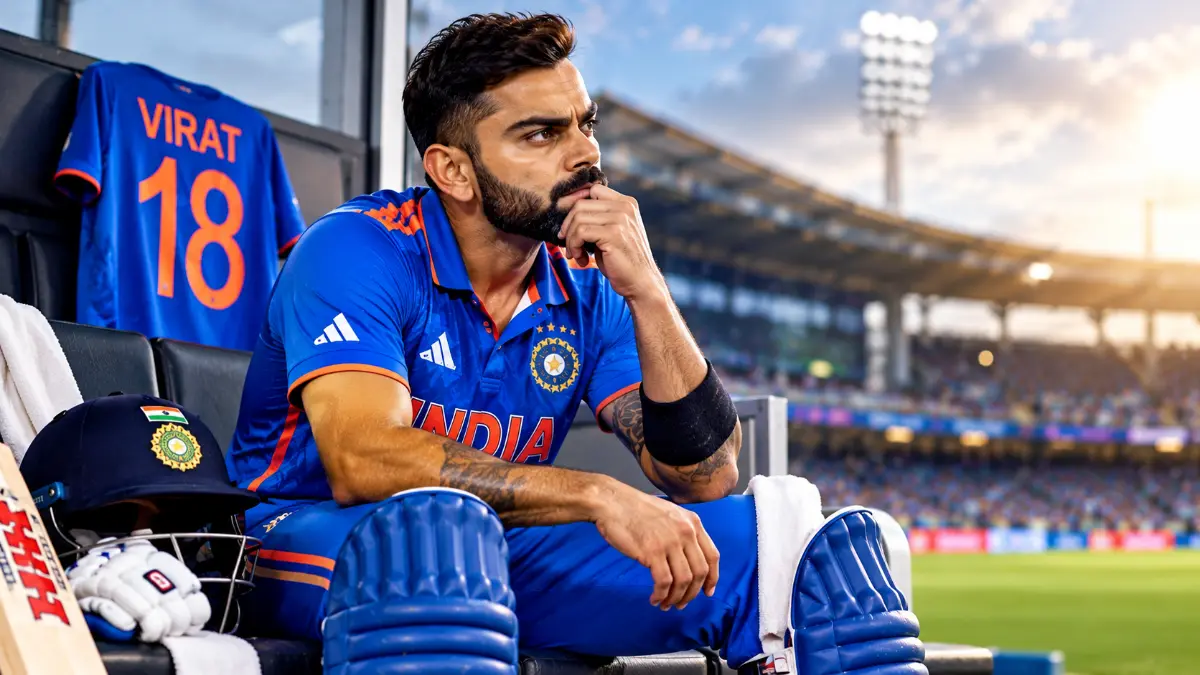
Why Isn’t Kohli in the 1st ODI If you are wondering why Kohli is missing from the 1st ODI, it all comes down to which match. He did participate in India’s first ODI against West Indies on September 27, 2026, and he scored 139*,* but missed India’s first ODI against England on February 6, 2025, due to a sore right knee.
That matters because an injury report older than a day can find itself alongside fresh cricket results, and the inference may be that Kohli is missing from a match in which he did play.
Quick Answer
| Question | Quick answer |
| Why is Kohli not in 1st ODI? | It depends on which first ODI you mean |
| IND vs WI, Sept. 27, 2026 | Kohli played |
| Kohli’s score vs West Indies | 139* off 88 balls |
| IND vs ENG, Feb. 6, 2025 | Kohli missed the match |
| Why did he miss it? | Sore right knee |
| Was Kohli dropped in 2025? | No, his absence was injury-related |
| Did he return for the 2nd ODI? | Yes |
| Last updated | September 28, 2026 |
In the 2026 West Indies opener at Thiruvananthapuram, Kohli’s 139 not out helped India chase 296 and win by eight wickets. The innings was also his 55th ODI century and took him past 15,000 ODI runs.
Is Virat Kohli Playing the 1st ODI?
Yes, if you’re talking about the India vs West Indies 1st ODI on September 27, 202,6 then only Virat Kohli was associated with India.
In fact, your assumption about him is especially wrong, depending on how he plays. 249 runs in just 137 balls, with Kohli scoring (139 not out off 88) and captain Shubman Gill making a century (110). India achieved the target of 296 runs set by West Indies in 41.4 overs with eight wickets in hand
Which means Kohli “not available for 1st ODI” must not be read as – he pulls out of West Indies-opening-an-account in 2026. Instead, they could cite an earlier match involving India-most obviously the first ODI of the subsequent series against England in February 2025
- Read more: Why is Kohli not in 1st ODI?
Was Kohli in India’s Playing XI Against West Indies?
Yes. Kohli played at his familiar No. 3 position at Greenfield International Stadium in Thiruvananthapuram.
The match became a major milestone day for him. His unbeaten 139 contained 10 fours and nine sixes, and his partnership with Gill put India firmly in control of the chase.
His innings also took him beyond 15,000 ODI runs and produced his 55th ODI century.
The important facts are straightforward:
Match: India vs West Indies, 1st ODI
Date: September 27, 2026
Venue: Greenfield International Stadium, Thiruvananthapuram
Kohli’s score: 139* from 88 balls
Result: India won by eight wickets
Therefore, Kohli was not missing from this particular first ODI.
Was Kohli Injured, Rested or Dropped?
None of those descriptions applies to Kohli’s participation in the September 2026 West Indies opener.
He played, batted at No. 3 and remained unbeaten at the end of India’s chase. His appearance and century provide a much stronger answer than pre-match speculation or an old injury article.
This illustrates an important rule when following cricket online: check the date and opponent before interpreting an injury headline.
A report saying “Kohli misses 1st ODI” may be perfectly accurate for one series and completely wrong for another.
- Read more: Why is Kohli not in 1st ODI?
Why Did Virat Kohli Miss the 1st ODI Against England in 2025?
This is the match that more closely matches the question “Why is Kohli not in the 1st ODI?”
Virat Kohli missed India’s first ODI against England at Nagpur on February 6, 2025, because of a problem with his right knee.
At the toss, then-captain Rohit Sharma confirmed that Kohli would not play because of the knee issue. The BCCI’s update described it as a sore right knee.
This was therefore an injury-related absence-not evidence that Kohli had been dropped for performance or tactical reasons.
India went ahead without him and defeated England by four wickets, successfully chasing 249.
- Read more: Why is Kohli not in 1st ODI?
What Happened to Kohli’s Knee?
The problem emerged immediately before the series opener.
Reporting from Nagpur showed Kohli with strapping around his right knee during the pre-match period. He warmed up and underwent fitness checks, but India’s medical team ultimately decided against playing him.
Rohit Sharma said at the toss that Kohli had developed the knee problem the previous night. The official description available at the time was simply a sore right knee.
That wording is important.
There is no need to diagnose a more specific injury based on photographs, video clips, or social-media speculation. Unless the team provides a medical diagnosis, “sore right knee” is the appropriate description.
Who Confirmed Kohli’s Injury?
The information came from authoritative sources rather than simply social-media rumors.
Rohit Sharma announced Kohli’s absence at the toss, explaining that he had developed a knee problem. The BCCI subsequently stated that Kohli was unavailable for selection because of a sore right knee.
When checking an injury-related cricket story, a useful source hierarchy is:
- Official team or cricket-board statement
- Captain’s comments at the toss or press conference
- Confirmed playing XI and match scorecard
- Established cricket/news reporting
- Unverified social-media claims
That order helps separate confirmed information from rumors.
- Read more: Why is Kohli not in 1st ODI?
Was Kohli Dropped From the Team?
No. The available evidence indicates that Kohli missed the Nagpur ODI because of his knee problem.
India Today reported that he was unavailable because of the injury and had undergone fitness checks before the toss.
There is a major difference between being dropped and being unavailable through injury.
A dropped player is left out as a selection decision. An injured player may still be part of the team’s plans but cannot safely participate in that particular match.
Kohli’s quick return in the same series further confirms that the Nagpur absence was temporary.
Who Replaced Kohli in the 1st ODI?
Yashasvi Jaiswal came into India’s XI and made his ODI debut in Nagpur. But saying that Jaiswal simply “replaced Kohli” does not fully explain what happened.
India reorganized its batting lineup.
Shreyas Iyer batted at No. 3, while Shubman Gill came in at No. 4. Iyer then played a crucial attacking innings of 59 from 36 balls as India chased England’s 248.
Iyer later revealed that his inclusion had come at short notice after Kohli became unavailable.
How India’s Batting Order Changed Without Kohli
| Role/change | Player |
| Opening pair | Rohit Sharma and Yashasvi Jaiswal |
| No. 3 | Shreyas Iyer |
| No. 4 | Shubman Gill |
| Kohli | Unavailable with a sore right knee |
| Major middle-order contribution | Iyer-59 off 36 |
This is why describing one player as Kohli’s direct replacement can be misleading.
Removing a regular No. 3 can trigger several changes throughout a batting order. India used Jaiswal at the top, moved Iyer into the No. 3 position and had Gill bat at No. 4.
Iyer’s aggressive 59 helped make the reshuffle work on the day.
- Read more: Why is Kohli not in 1st ODI?
Did Kohli Return for the 2nd ODI?
Yes.
Kohli returned to India’s playing XI for the second ODI against England at Barabati Stadium in Cuttack on February 9, 2025.
His comeback ended any uncertainty about whether the knee issue would keep him out for a prolonged period.
Kohli scored 5 from 8 balls before Adil Rashid dismissed him caught behind. India nevertheless chased England’s 304, reaching 308/6 in 44.3 overs and winning by four wickets. Rohit Sharma led the chase with 119.
So the timeline is clear:
February 6, 2025: Kohli missed the first ODI with a sore right knee.
February 9, 2025: Kohli returned for the second ODI and scored 5.
This is more useful than relying on reports published immediately after the first ODI saying he was merely “expected” to return.
- Read more: Why is Kohli not in 1st ODI?
Which “1st ODI” Are Fans Talking About?
This is the key source of confusion surrounding the search.
Virat Kohli has played in many series openers, so a headline about his absence from “the 1st ODI” becomes ambiguous once that series is over.
Two matches are especially important here.
India vs England-February 2025
Kohli did not play in the first ODI at Nagpur on February 6, 2025.
The reason was a sore right knee, confirmed around the time of the toss.
India still won the match by four wickets, with Shubman Gill, Shreyas Iyer and Axar Patel making significant batting contributions.
Kohli returned three days later for the second ODI.
India vs West Indies-September 2026
The situation was completely different when India opened its ODI series against West Indies on September 27, 2026.
Kohli played and produced one of the defining performances of the match: 139 not out from 88 balls.
India won by eight wickets, with Kohli and Gill both making centuries.
Here is the simplest comparison:
| 1st ODI | Kohli status | What happened? |
| IND vs ENG – Feb. 6, 2025 | ❌ Did not play | Sore right knee |
| IND vs WI – Sept. 27, 2026 | ✅ Played | Scored 139* |
This is why the opponent and date matter whenever you encounter an old headline about Kohli missing a match.
“Not Playing,” “Did Not Bat” and “Dropped” Are Not the Same
Cricket terminology can also create unnecessary confusion.
A player being absent from the scorecard’s batting section does not automatically mean he was left out of the match.
Not in the Playing XI
If a player is not named in the final XI, he does not participate as one of that team’s 11 selected players.
The reason might be an injury, illness, rest, suspension, or a selection decision.
That is what happened with Kohli in Nagpur in February 2025: he was unavailable for selection because of his knee problem.
Selected but Did Not Bat
A player can be part of the playing XI without batting.
For example, if a team wins while only three batters are required, the remaining players are listed as “did not bat.” They still played the match.
This distinction is particularly important when looking only at batting scorecards.
Rested vs Injured vs Dropped
| Status | What it means |
| Injured | A physical problem prevents or limits availability |
| Rested | Team management deliberately gives the player time off |
| Dropped | The player is omitted primarily as a selection decision |
| Did not bat | The player was in the XI but was not required to bat |
| Substitute fielder | Fielded as a substitute but was not necessarily in the original XI |
These terms should not be used interchangeably.
Calling an injured player “dropped,” for example, can completely change the meaning of what actually happened.
Why Kohli’s Availability Matters for India’s ODI Team
Kohli remains a major part of India’s ODI batting structure, particularly at No. 3.
His September 2026 performance against West Indies showed that clearly: his unbeaten 139 helped India turn a target of 296 into a comfortable eight-wicket victory.
His presence also matters because ODI cricket is now his only international format. ICC reported in 2026 that Kohli had retired from Tests and T20Is and was continuing internationally in ODIs.
Kohli’s Role at No. 3
The No. 3 position requires adaptability.
If an opener is dismissed early, the No. 3 batter may effectively face a new ball and has to stabilize the innings. If the openers produce a strong partnership, the same batter may arrive with a platform to attack.
Kohli’s role can therefore involve:
- rebuilding after an early wicket,
- forming partnerships through the middle overs,
- rotating strike against spin,
- managing the required rate during a chase, and
- accelerating when the match situation allows.
His 139* against West Indies was a good example of how an experienced No. 3 can control a chase after arriving early enough to shape the innings.
Kohli’s ODI Milestones to Verify
Kohli’s numbers continue to change, so statistics should always be dated.
As of September 27, 2026, West Indies opener Kohli had crossed 15,000 ODI runs and registered his 55th ODI hundred. He became only the second batter to reach 15,000 runs in the format.
For any future updates to this article, recheck:
- ODI matches played
- career runs
- batting average
- centuries
- half-centuries
- latest innings
- record against the current opponent
- current international status
This prevents an otherwise accurate article from becoming outdated simply because a career total changed after another match.
How to Check Whether Kohli Is Playing Today
If you are trying to determine whether Kohli is actually playing an ODI today, don’t rely solely on a search headline.
Use this simple process.
Step 1: Check the confirmed playing XI after the toss.
The final XI is much more reliable than a predicted lineup published hours earlier.
Step 2: Check official team updates.
An official cricket board announcement may explain whether a player is injured or unavailable.
Step 3: Open the live scorecard.
It will show the confirmed teams and match status.
Step 4: Separate predictions from confirmation.
A “probable XI” is an editorial prediction, not a team announcement.
Step 5: Check the publication date.
This is especially important for recurring searches such as “Why is Kohli not playing today?”
A 2025 injury article appearing in a 2026 search result does not mean the injury is current.
Don’t Trust a Predicted XI as Confirmation
Predicted XIs are useful before a match, but they are still projections.
Selection can change because of fitness tests, pitch conditions, workload management, or a tactical decision made shortly before the toss.
Kohli’s 2025 Nagpur absence is a good example. He had been part of India’s ODI squad, but the knee problem meant he was unavailable when the final XI was confirmed.
Treat the official playing XI after the toss as the definitive answer.
Check the Date Before Reading an Injury Report
The difference between the two Kohli stories shows why dates matter:
February 2025: Kohli missed the first ODI against England because of a sore right knee.
September 2026: Kohli played the first ODI against West Indies and scored an unbeaten 139.
Those statements do not contradict each other. They describe different matches separated by more than a year.
So, Why Was Kohli Not in the 1st ODI?
If you mean the India vs England first ODI in Nagpur on February 6, 2025, Virat Kohli was not in the playing XI because of a sore right knee. His absence was injury-related rather than a decision to drop him, and he returned for the second ODI three days later.
If you mean the India vs West Indies first ODI on September 27, 2026, Kohli was not absent at all. He played at No. 3, scored 139 not out, crossed 15,000 ODI runs and helped India win by eight wickets.
Whenever you see an old “Kohli not playing” headline, check the opponent, match date, and confirmed playing XI before assuming it refers to the current game.
Frequently Asked Questions
World-DreamKuldeep Yadav is not in the squad for Kohli in 1st ODI: When and why did Kohli miss out on the 1st ODI?
Missed the 1st ODI-KS Bharat (right knee; missed first ODI) – India vs England, Feb 6, 2025. Yes, he did, and from Sept 27, 2026 onward vs WI -139*- as in India.
Why did Virat Kohli not come in the 1st ODI against England?
Kohli had skipped the ODI played in Nagpur on February 6, 2025 because of an injured right knee. At the toss, Rohit Sharma had all but been confirmed with a knee problem after the BCCI stated he was ruled out due to “unavailability for selection”.
Virat Kohli (1st ODI v West Indies | 2026)
Yes. India chased 214 and beat New Zealand by eight wickets in the first ODI in Thiruvananthapuram (Sep 27, 2026); Kohli made an unbeatable139 off 88 balls.
Why is Virat Kohli out of the India ODI team?
Unless we’re referring to the case in February 2025 that’s discussed here. Wasn’t picked for the first ODI vs England, but missed out due to a knee injury.
Virat Kohli injury before England 1st ODI: What happened?
“The problem is with a sore right knee: BCCI said. There was even speculation of him strapping his knees with support tapes and also having to be put through fitness tests immediately before the start.
Ruturaj Gaikwad replaced Virat Kohli in the 1st ODI vs London.
Yashasvi Jaiswal made his ODI debut in place of an injured player in the XI. India also made changes to the batting order, promoting Shreyas Iyer at No.3 while pushing the in-form Shubman Gill down to bat at four.
But here the question arises: Did Kohli take a fitness test before playing the 1st ODI?
The BCI had conducted a fitness test on Kohli prior to the ODI, ruled him out for the Nagpur match, but picked him for the match. He was spotted on the turf with taping around his right knee.
One of the records that could be broken: Virat Kohli’s 1st ODI vs West Indies (2026)
Kohli remained not out on 139 from 88 balls, hitting ten fours and nine sixes. Chase IND 2966 by 8 wickets (Remaining 4 balls)
And this is the only interview of yours that he did not take. -Jock Baird.Txt: February 2013}Other details about Virat Kohli ODI player, Ans 13:2010-01-01
As of 28 September 2026, he is an active ODI cricketer for India. He hasn’t said goodbye to Tests and T20Is, so it’s basically his last international window in ODIs.
You may check this link to see whether Virat Kohli plays ODI Today.
TOSS: Playing XI, team news, and live scorecard after the toss.s You don’t treat a predicted XI or an old injury article as gospel, and you always search for publication years/counterparts.
