

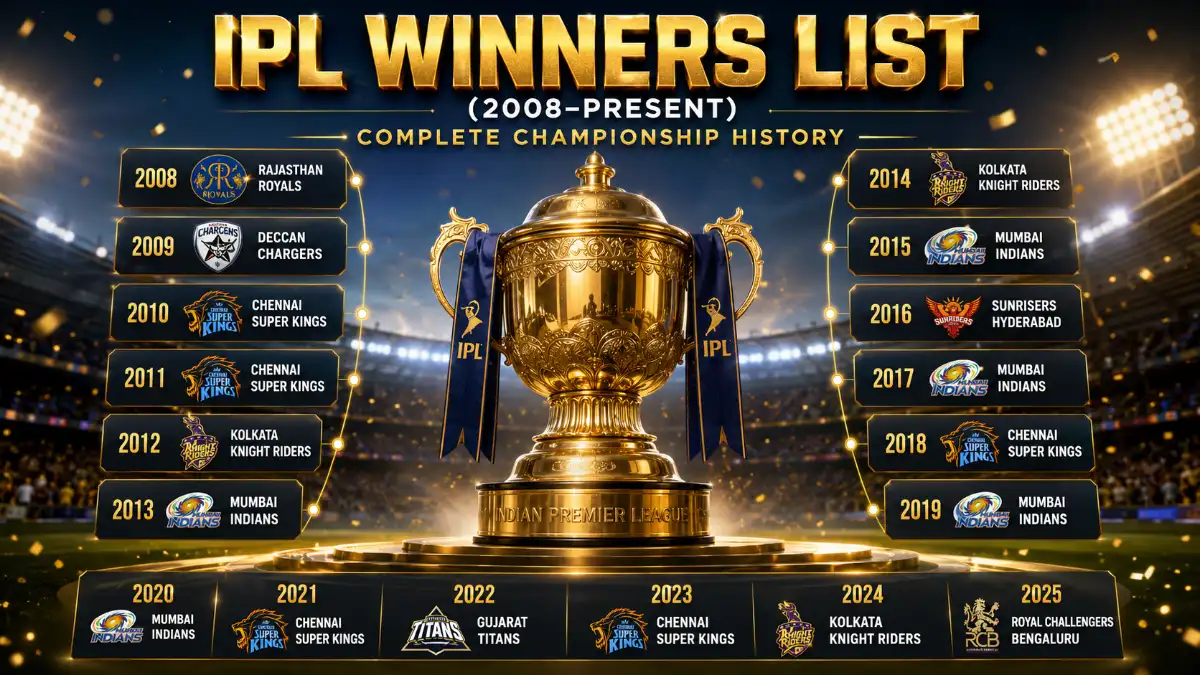
This IPL winners list covers every completed Indian Premier League season from Rajasthan Royals’ inaugural title in 2008 to Royal Challengers Bengaluru’s 2026 championship. Mumbai Indians and Chennai Super Kings remain the joint-most successful IPL teams with five titles each, while Kolkata Knight Riders have three and Royal Challengers Bengaluru have two.
The table below answers the core search query first: who won each IPL season, which team finished runner-up, how the final was decided, and where it was played. The rest of this guide adds the context that a basic winners table misses-final-appearance records, captaincy achievements, defining title eras, historic final totals and franchise performance trends.
IPL Winners List Year-Wise
| Season | IPL Winner | Runner-Up | Final Result | Final Venue |
| 2008 | Rajasthan Royals | Chennai Super Kings | Rajasthan Royals won by 3 wickets | DY Patil Stadium, Mumbai |
| 2009 | Deccan Chargers | Royal Challengers Bangalore | Deccan Chargers won by 6 runs | Wanderers Stadium, Johannesburg |
| 2010 | Chennai Super Kings | Mumbai Indians | Chennai Super Kings won by 22 runs | DY Patil Stadium, Mumbai |
| 2011 | Chennai Super Kings | Royal Challengers Bangalore | Chennai Super Kings won by 58 runs | M. A. Chidambaram Stadium, Chennai |
| 2012 | Kolkata Knight Riders | Chennai Super Kings | Kolkata Knight Riders won by 5 wickets | M. A. Chidambaram Stadium, Chennai |
| 2013 | Mumbai Indians | Chennai Super Kings | Mumbai Indians won by 23 runs | Eden Gardens, Kolkata |
| 2014 | Kolkata Knight Riders | Kings XI Punjab | Kolkata Knight Riders won by 3 wickets | M. Chinnaswamy Stadium, Bengaluru |
| 2015 | Mumbai Indians | Chennai Super Kings | Mumbai Indians won by 41 runs | Eden Gardens, Kolkata |
| 2016 | Sunrisers Hyderabad | Royal Challengers Bangalore | Sunrisers Hyderabad won by 8 runs | M. Chinnaswamy Stadium, Bengaluru |
| 2017 | Mumbai Indians | Rising Pune Supergiant | Mumbai Indians won by 1 run | Rajiv Gandhi International Stadium, Hyderabad |
| 2018 | Chennai Super Kings | Sunrisers Hyderabad | Chennai Super Kings won by 8 wickets | Wankhede Stadium, Mumbai |
| 2019 | Mumbai Indians | Chennai Super Kings | Mumbai Indians won by 1 run | Rajiv Gandhi International Stadium, Hyderabad |
| 2020 | Mumbai Indians | Delhi Capitals | Mumbai Indians won by 5 wickets | Dubai International Cricket Stadium, Dubai |
| 2021 | Chennai Super Kings | Kolkata Knight Riders | Chennai Super Kings won by 27 runs | Dubai International Cricket Stadium, Dubai |
| 2022 | Gujarat Titans | Rajasthan Royals | Gujarat Titans won by 7 wickets | Narendra Modi Stadium, Ahmedabad |
| 2023 | Chennai Super Kings | Gujarat Titans | Chennai Super Kings won by 5 wickets, DLS method | Narendra Modi Stadium, Ahmedabad |
| 2024 | Kolkata Knight Riders | Sunrisers Hyderabad | Kolkata Knight Riders won by 8 wickets | M. A. Chidambaram Stadium, Chennai |
| 2025 | Royal Challengers Bengaluru | Punjab Kings | Royal Challengers Bengaluru won by 6 runs | Narendra Modi Stadium, Ahmedabad |
| 2026 | Royal Challengers Bengaluru | Gujarat Titans | Royal Challengers Bengaluru won by 5 wickets | Narendra Modi Stadium, Ahmedabad |
Royal Challengers Bengaluru’s 2025 victory ended an 18-year wait for their first IPL trophy. They defended 190 against Punjab Kings, winning by six runs at Ahmedabad. In 2026, RCB retained the title by chasing Gujarat Titans’ 155/8 and reaching 161/5 with two overs remaining.
Read Also: Most Runs in Test Cricket: Updated All-Time Records, Rankings, and Key Milestones
Most IPL Titles by Team
Mumbai Indians and Chennai Super Kings are the two most decorated franchises in IPL history, with five titles each. Their records, however, tell different stories: Chennai have appeared in more finals, while Mumbai have converted a larger share of their final appearances into trophies.
IPL titles by franchise
| Team | IPL Titles |
| Mumbai Indians | 5 |
| Chennai Super Kings | 5 |
| Kolkata Knight Riders | 3 |
| Royal Challengers Bengaluru | 2 |
| Rajasthan Royals | 1 |
| Deccan Chargers | 1 |
| Sunrisers Hyderabad | 1 |
| Gujarat Tit |
| Rank | Team | Titles | Winning Seasons |
| 1 | Mumbai Indians | 5 | 2013, 2015, 2017, 2019, 2020 |
| 1 | Chennai Super Kings | 5 | 2010, 2011, 2018, 2021, 2023 |
| 3 | Kolkata Knight Riders | 3 | 2012, 2014, 2024 |
| 4 | Royal Challengers Bengaluru | 2 | 2025, 2026 |
| 5 | Rajasthan Royals | 1 | 2008 |
| 5 | Deccan Chargers | 1 | 2009 |
| 5 | Sunrisers Hyderabad | 1 | 2016 |
| 5 | Gujarat Titans | 1 | 2022 |
RCB’s second successive title placed them alongside Chennai Super Kings and Mumbai Indians as franchises that have defended the IPL trophy. Chennai won back-to-back titles in 2010 and 2011, Mumbai did so in 2019 and 2020, and RCB achieved the feat in 2025 and 2026.
Read Also: Most Runs in ODI Cricket: Updated All-Time Rankings, Records, and Milestones
IPL Finals Appearances and Win Percentage
Title totals do not fully explain IPL success. Final appearances show consistency across seasons, while final win percentage shows how effectively a team converts its best opportunities into trophies.
| Team | Finals Played | Finals Won | Finals Lost | Final Win Rate |
| Chennai Super Kings | 10 | 5 | 5 | 50.0% |
| Mumbai Indians | 6 | 5 | 1 | 83.3% |
| Royal Challengers Bengaluru | 5 | 2 | 3 | 40.0% |
| Kolkata Knight Riders | 4 | 3 | 1 | 75.0% |
| Gujarat Titans | 3 | 1 | 2 | 33.3% |
| Sunrisers Hyderabad | 3 | 1 | 2 | 33.3% |
| Rajasthan Royals | 2 | 1 | 1 | 50.0% |
| Punjab Kings | 2 | 0 | 2 | 0.0% |
| Deccan Chargers | 1 | 1 | 0 | 100.0% |
| Delhi Capitals | 1 | 0 | 1 | 0.0% |
| Rising Pune Supergiant | 1 | 0 | 1 | 0.0% |
Chennai Super Kings’ 10 final appearances are the clearest measure of sustained IPL consistency. Their record spans different squad cycles, venues and formats, with five titles and five runner-up finishes. Mumbai Indians’ five victories from six finals represent the best conversion rate among franchises with at least three final appearances.
Kolkata Knight Riders have also been highly efficient in final matches. They won in 2012 and 2014, lost to Chennai in 2021, then returned to win the 2024 final decisively against Sunrisers Hyderabad.
Smaller sample sizes require caution. Deccan Chargers won their only final in 2009, but they played only five IPL seasons before the franchise ceased operations. Gujarat Titans reached three finals in their first five completed seasons, an exceptional early record, but lost the 2023 and 2026 deciders.
Mumbai Indians vs Chennai Super Kings
Mumbai Indians and Chennai Super Kings define the IPL’s most successful rivalry. They share the title record, but their championship paths have not been identical.
| Measure | Mumbai Indians | Chennai Super Kings |
| IPL titles | 5 | 5 |
| Final appearances | 6 | 10 |
| Final wins | 5 | 5 |
| Final win rate | 83.3% | 50.0% |
| First IPL title | 2013 | 2010 |
| Most successful captain | Rohit Sharma | MS Dhoni |
| Titles under that captain | 5 | 5 |
| Consecutive titles | 2019 and 2020 | 2010 and 2011 |
Chennai’s advantage is durability. The franchise has repeatedly returned to the final after rebuilding phases and player transitions, which makes its record about more than a single dominant squad. The team’s consistent use of experienced players, flexible role allocation and calm game management has helped it remain competitive over a long period.
Mumbai’s record is defined by exceptional peak performance. Their five titles came in eight seasons between 2013 and 2020, and they won four trophies in six editions from 2015 onward. Their 2017 and 2019 finals were each decided by one run, underlining their ability to execute under the most demanding conditions.
The comparison therefore depends on the question. For sustained finals qualification, Chennai lead. For converting final appearances into championships, Mumbai lead. For total trophies, they remain level.
Read Also: Most Runs in T20I: Highest Run Scorers in T20 International Cricket
Most Successful IPL Captains
MS Dhoni and Rohit Sharma are the most successful IPL captains, with five titles each. Dhoni led Chennai Super Kings to every one of their five championships, while Rohit Sharma captained Mumbai Indians in all five of theirs.
| Captain | Team | IPL Titles as Captain | Winning Seasons |
| MS Dhoni | Chennai Super Kings | 5 | 2010, 2011, 2018, 2021, 2023 |
| Rohit Sharma | Mumbai Indians | 5 | 2013, 2015, 2017, 2019, 2020 |
| Gautam Gambhir | Kolkata Knight Riders | 2 | 2012, 2014 |
| Rajat Patidar | Royal Challengers Bengaluru | 2 | 2025, 2026 |
| Shane Warne | Rajasthan Royals | 1 | 2008 |
| Adam Gilchrist | Deccan Chargers | 1 | 2009 |
| David Warner | Sunrisers Hyderabad | 1 | 2016 |
| Hardik Pandya | Gujarat Titans | 1 | 2022 |
| Shreyas Iyer | Kolkata Knight Riders | 1 | 2024 |
The captain’s role in IPL finals extends beyond tactical field placements. A successful captain must decide how to use the new ball, protect weaker bowlers, assess whether a target is above or below par, maintain batting order flexibility and manage pressure in the final overs.
Dhoni’s record is associated with long-term continuity and pragmatic in-game decision-making. Rohit’s title success with Mumbai came from a core that combined elite overseas players with leading Indian talent and specialist death bowling. Gambhir’s two titles established KKR as a major early-era franchise, while Patidar’s consecutive wins reshaped RCB’s championship history.
Every IPL Winning Captain by Season
| Season | Winning Team | Captain |
| 2008 | Rajasthan Royals | Shane Warne |
| 2009 | Deccan Chargers | Adam Gilchrist |
| 2010 | Chennai Super Kings | MS Dhoni |
| 2011 | Chennai Super Kings | MS Dhoni |
| 2012 | Kolkata Knight Riders | Gautam Gambhir |
| 2013 | Mumbai Indians | Rohit Sharma |
| 2014 | Kolkata Knight Riders | Gautam Gambhir |
| 2015 | Mumbai Indians | Rohit Sharma |
| 2016 | Sunrisers Hyderabad | David Warner |
| 2017 | Mumbai Indians | Rohit Sharma |
| 2018 | Chennai Super Kings | MS Dhoni |
| 2019 | Mumbai Indians | Rohit Sharma |
| 2020 | Mumbai Indians | Rohit Sharma |
| 2021 | Chennai Super Kings | MS Dhoni |
| 2022 | Gujarat Titans | Hardik Pandya |
| 2023 | Chennai Super Kings | MS Dhoni |
| 2024 | Kolkata Knight Riders | Shreyas Iyer |
| 2025 | Royal Challengers Bengaluru | Rajat Patidar |
| 2026 | Royal Challengers Bengaluru | Rajat Patidar |
IPL Final Records: Highest Totals, Lowest Totals and Closest Margins
Sunrisers Hyderabad’s 208/7 against Royal Challengers Bangalore in 2016 remains the highest team total in an IPL final. SRH won that match by eight runs. Their 2024 score of 113 against Kolkata Knight Riders is, by contrast, the lowest total in an IPL final. KKR chased the target with eight wickets remaining.
| IPL Final Record | Team | Record | Opponent | Season |
| Highest final total | Sunrisers Hyderabad | 208/7 | Royal Challengers Bangalore | 2016 |
| Lowest final total | Sunrisers Hyderabad | 113 | Kolkata Knight Riders | 2024 |
| Lowest successful defence | Mumbai Indians | 129/8 | Rising Pune Supergiant | 2017 |
| Narrowest win margin | Mumbai Indians | 1 run | Rising Pune Supergiant | 2017 |
| Narrowest win margin | Mumbai Indians | 1 run | Chennai Super Kings | 2019 |
| Largest win by runs | Chennai Super Kings | 58 runs | Royal Challengers Bangalore | 2011 |
| Largest win by wickets | Chennai Super Kings | 8 wickets | Sunrisers Hyderabad | 2018 |
| Largest win by wickets | Kolkata Knight Riders | 8 wickets | Sunrisers Hyderabad | 2024 |
Read Also: Why Virat Kohli Wears Jersey Number 18
The 2016 final: IPL’s highest-scoring title match
The 2016 final was a high-scoring contest between Sunrisers Hyderabad and Royal Challengers Bangalore. SRH made 208/7, with the innings setting a demanding target at the M. Chinnaswamy Stadium. RCB threatened to overhaul it, but SRH held their nerve to win by eight runs.
This final remains an important example of how title matches can change quickly. A target above 200 is not automatically decisive on a batting-friendly surface, particularly when the chasing team has aggressive top-order options. SRH’s win depended on maintaining wicket-taking pressure rather than simply defending the score.
The 2017 final: Mumbai’s lowest successful defence
Mumbai Indians defended 129/8 against Rising Pune Supergiant in the 2017 final, winning by a single run. It is the lowest total successfully defended in an IPL final.
The match is a reminder that IPL finals are not always won by the side with the stronger batting innings. Mumbai’s bowlers used the conditions effectively, maintained pressure through the middle overs and executed their plans at the death. The result also illustrates why final scores should be interpreted in the context of pitch behaviour, dew, bowling quality and the pressure created by the occasion.
The 2023 final: a DLS chase decided on the last ball
Rain interrupted the 2023 final between Chennai Super Kings and Gujarat Titans. The target was revised under the Duckworth-Lewis-Stern method, leaving Chennai with 171 to win from 15 overs.
CSK reached the target on the last ball, securing their fifth IPL championship. The finish made the match one of the most dramatic finals in tournament history, not only because of the weather interruption but also because the revised chase still demanded sustained scoring under intense pressure.
The 2024 final: KKR’s complete performance
Kolkata Knight Riders’ win over Sunrisers Hyderabad in 2024 was defined by bowling control. SRH were dismissed for 113, the lowest total in an IPL final, and KKR completed the chase with eight wickets to spare.
Unlike close finals that hinge on a last-over decision, this was a match shaped from the opening phase. KKR’s ability to take wickets early prevented SRH from using their high-tempo batting approach. The final demonstrated the value of a bowling attack that can create pressure rather than merely contain runs.
IPL Title Eras and Changing Winning Models
The history of IPL champions can be divided into broad competitive phases. These are not rigid boundaries, but they help explain how the league’s successful teams have adapted as squads, tactics and playing conditions changed.
2008-2011: The launch and leadership era
Rajasthan Royals won the first IPL through collective balance and Shane Warne’s leadership. Deccan Chargers responded from a bottom-place finish in 2008 to become champions in 2009 under Adam Gilchrist.
Chennai Super Kings then established the first sustained title run, winning in 2010 and 2011. Their back-to-back titles were the league’s first and set a benchmark for squad continuity. The period showed that teams could win through contrasting models: an underdog collective, a strong turnaround, or a stable leadership group with repeated finals experience.
2012-2015: KKR and Mumbai establish title credentials
Kolkata Knight Riders won in 2012 and 2014, both under Gautam Gambhir. Their success blended aggressive batting with tactical use of spin and match-specific bowling plans.
Mumbai Indians won their first title in 2013, then added trophies in 2015, 2017, 2019 and 2020. The franchise became particularly formidable in close knockout games. Rather than relying on one player, Mumbai’s winning cycles featured a strong Indian base, established overseas performers, specialist bowling options and players capable of fulfilling defined roles.
Read Also: Rohit Sharma: Biography, Career Timeline, IPL Career, Captaincy, and Latest Profile
2016-2020: Marginal gains decide finals
This era included Sunrisers Hyderabad’s 2016 win and Mumbai’s one-run victories in 2017 and 2019. It highlighted the importance of defending totals, fielding well under pressure and making precise decisions at the death.
The period also showed that a team’s league-stage position is not the only determinant of championship success. Playoff cricket is compressed and unforgiving. Match-ups, venue conditions, player form and a single tactical decision can have outsized importance in a final.
2021-2026: New contenders and renewed dynasties
Chennai won in 2021 and 2023, while Gujarat Titans won in their debut season in 2022. Kolkata returned to the top in 2024, and Royal Challengers Bengaluru won in 2025 before defending the title in 2026.
This period reflects the effects of evolving auction strategies and more flexible squad construction. Teams increasingly require batting depth, role-specific bowlers, adaptable overseas combinations and Indian players capable of maintaining quality when international stars are unavailable.
Why Some Teams Convert Final Appearances Better Than Others
A final is only one match, so its result can be influenced by conditions and small moments. Still, certain patterns are visible across IPL history.
- Stable leadership matters: Teams with repeated success usually have captains and support systems that can manage pressure without overreacting to short-term setbacks.
- Clear player roles matter: Successful teams know who attacks in the powerplay, who anchors the innings, who bowls at the death, and who adjusts to match-ups.
- Indian depth matters: Overseas players can transform a side, but teams that win consistently also depend on domestic players to deliver in high-pressure moments.
- Bowling remains decisive: High-scoring league matches can create the impression that batting dominates the IPL, but final results repeatedly show the value of wickets, fielding and death-overs execution.
- Auction value is not just price: A title-winning squad does not need the most expensive XI. It needs balance across specialist roles and enough depth to withstand injuries, loss of form and changing conditions.
IPL Winning Teams: Franchise Context
Rajasthan Royals
Rajasthan Royals won the inaugural season in 2008. Their title remains one of the IPL’s most memorable because they were not widely expected to dominate before the tournament began. The team’s success is often associated with Shane Warne’s leadership and a group that exceeded pre-season expectations.
Rajasthan returned to the final in 2022 but lost to the Gujarat Titans. Their history demonstrates that one early championship does not guarantee continued title success; the IPL’s auction cycles and intense competition demand regular rebuilding.
Deccan Chargers
Deccan Chargers won the 2009 IPL after finishing last in the 2008 season. Their turnaround remains one of the tournament’s sharpest year-to-year improvements.
The franchise’s records should be kept separate from Sunrisers Hyderabad. Both represented Hyderabad, but they were different teams with separate ownership structures and player histories. Deccan Chargers ceased participation after the 2012 season.
Chennai Super Kings
Chennai Super Kings have five IPL titles and 10 final appearances. Their most distinctive achievement is sustained competitiveness across multiple periods rather than dominance in only one short stretch.
The franchise has won under MS Dhoni in 2010, 2011, 2018, 2021 and 2023. Its ability to reach five more finals without winning them reinforces how often it has remained in contention for the championship.
Read Also: MS Dhoni: Biography, Records, Captaincy, Stats, IPL Career, Retirement, and Legacy
Mumbai Indians
Mumbai Indians also have five titles, all won under Rohit Sharma. Their most successful stretch came from 2013 to 2020, when they claimed five trophies in eight seasons.
Mumbai’s final record is especially strong: five wins from six appearances. Their ability to prevail in close finals, particularly in 2017 and 2019, is central to their championship identity.
Kolkata Knight Riders
Kolkata Knight Riders have three titles, won in 2012, 2014 and 2024. Their first two victories came under Gautam Gambhir, while their 2024 title followed a rebuilt campaign under Shreyas Iyer.
KKR’s final success rate is strong, with three wins from four appearances. Their 2024 victory was one of the most complete final performances in IPL history because it combined a low opposition total with a comfortable chase.
Sunrisers Hyderabad
Sunrisers Hyderabad won their only IPL title in 2016 under David Warner. Their 208/7 in that final remains the highest team total in an IPL championship match.
SRH reached the final again in 2018 and 2024 but lost both. The contrast between their 2016 high score and their 2024 low score of 113 shows how quickly final conditions and match control can shift.
Gujarat Titans
Gujarat Titans won the IPL in their first season, 2022, and reached the final in 2023 and 2026. This made them one of the most successful expansion teams in IPL history by early final appearances.
Their 2022 triumph was built around a balanced squad and a captain who contributed as an all-rounder. Their subsequent final defeats show the fine margins of title defence: reaching the last match is evidence of quality, but it does not guarantee another trophy.
Royal Challengers Bengaluru
Royal Challengers Bengaluru were runners-up in 2009, 2011 and 2016 before winning the title in 2025. The win removed one of the most frequently discussed gaps in IPL history: a major franchise with a passionate support base but no championship.
Their successful defence in 2026 gave RCB two titles in two seasons. The franchise’s final record changed from zero wins in three appearances before 2025 to two wins in five appearances after the 2026 final.
Punjab Kings
Punjab Kings, previously known as Kings XI Punjab, have reached two IPL finals and lost both. Their first came in 2014, when they lost to Kolkata Knight Riders; their second came in 2025, when RCB beat them by six runs.
The 2014 and 2025 records belong to the same franchise. The 2021 name change from Kings XI Punjab to Punjab Kings did not create a new team for historical-statistics purposes.
Delhi Capitals
Delhi Capitals reached their first IPL final in 2020, losing to Mumbai Indians in Dubai. The franchise was known as Delhi Daredevils before 2019, and its historical records under both names belong to the same team.
Read more: Explore more cricket timelines, player profiles, team rivalries, and cricket records.
Rising Pune Supergiant
Rising Pune Supergiant reached the 2017 final and lost to Mumbai Indians by one run. The franchise played only in the 2016 and 2017 seasons, so its final record should be considered in the context of a very short competitive existence.
Frequently Asked Questions
Who has won the most IPL titles?
Mumbai Indians and Chennai Super Kings have won the most IPL titles, with five championships each. Mumbai won in 2013, 2015, 2017, 2019 and 2020. Chennai won in 2010, 2011, 2018, 2021 and 2023. Mumbai have converted five of six final appearances into titles, while Chennai have reached more finals overall.
Who won IPL 2026?
Royal Challengers Bengaluru won IPL 2026. They defeated Gujarat Titans by five wickets at Narendra Modi Stadium in Ahmedabad. Gujarat finished on 155/8, and RCB completed the chase at 161/5 in 18 overs. The win gave RCB their second IPL title and a second successive championship after their 2025 breakthrough.
Which team won the first IPL season?
Rajasthan Royals won the inaugural IPL in 2008. Led by Shane Warne, they defeated Chennai Super Kings by three wickets in the final at DY Patil Stadium. Rajasthan’s victory is considered a notable underdog achievement because they were not among the most heavily favoured teams before the first IPL season.
Which IPL captain has won the most titles?
MS Dhoni and Rohit Sharma are jointly the most successful IPL captains, with five titles each. Dhoni led Chennai Super Kings to five championships, while Rohit Sharma captained Mumbai Indians to all five of their titles. Gautam Gambhir is next with two titles as Kolkata Knight Riders captain.
Which IPL final had the highest team score?
Sunrisers Hyderabad’s 208/7 against Royal Challengers Bangalore in the 2016 final is the highest team total in IPL final history. SRH defended the score and won by eight runs. It remains a standout title match because RCB came close during the chase, making it a high-scoring contest rather than a one-sided result.
What is the lowest score in an IPL final?
Sunrisers Hyderabad made 113 against Kolkata Knight Riders in the 2024 final, the lowest total in IPL final history. KKR chased the target with eight wickets in hand to win their third IPL trophy. The result was shaped by KKR’s early wickets, which prevented SRH from establishing the aggressive batting rhythm that had defined much of their season.
Which IPL team has the best final win percentage?
Among teams with multiple final appearances, Mumbai Indians have the best IPL final win percentage. They have won five of their six finals, producing a conversion rate of 83.3%. Their only final defeat came against Chennai Super Kings in 2010. Mumbai’s five titles were all won under Rohit Sharma’s captaincy.
Which team has lost the most IPL finals?
Chennai Super Kings have lost the most IPL finals because they have also reached the most. They have played 10 finals, winning five and losing five. This is not necessarily a negative record: reaching the final 10 times is evidence of exceptional sustained competitiveness across the IPL’s history.
Are Kings XI Punjab and Punjab Kings the same franchise?
Yes. Kings XI Punjab was renamed Punjab Kings ahead of the 2021 season. It is the same franchise, so its 2014 runners-up finish as Kings XI Punjab, and its 2025 runners-up finish as Punjab Kings are part of the same IPL record. The rebrand did not reset the team’s history.
Are Deccan Chargers and Sunrisers Hyderabad the same IPL team?
No. Deccan Chargers and Sunrisers Hyderabad are separate IPL franchises. Deccan Chargers won the 2009 title and exited after the 2012 season. Sunrisers Hyderabad joined the league in 2013 and won their title in 2016. Their trophies, player records, final appearances, and franchise histories should be counted separately.
