

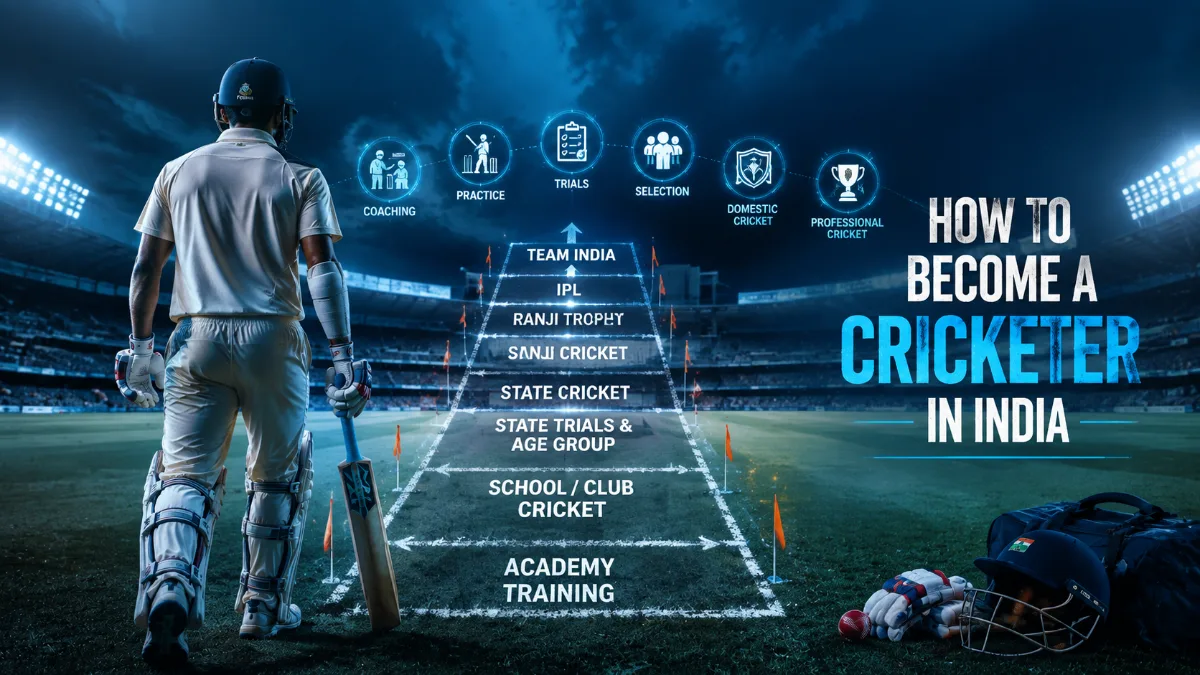
If you want to know how to become a cricketer in India, the realistic route is to build your ability through coaching and competitive cricket, enter the appropriate state or age-group pathway, perform consistently against stronger opposition, and progress toward senior domestic cricket. There is no single BCCI trial that guarantees a professional career, and joining an academy does not automatically lead to state, IPL or India selection.
The Indian domestic system provides opportunities across multiple age groups and formats. For 2026-27, the BCCI has scheduled 1,788 matches across men’s and women’s domestic cricket, including senior, U23, U19 and U16 men’s competitions and senior, U23, U19 and U15 women’s competitions.
Learn the fundamentals, train with quality coaching, play school or club cricket, follow your state association’s official pathway, perform in recognised competitions, and keep progressing to stronger levels. Your age, state, playing role and current level determine the most appropriate next step.
The Cricket Pathway in India
There is no universal ladder that every player must follow in the same order. A practical pathway looks like this:
Learn → Train → Compete → Enter the relevant pathway → Perform → Progress
| Your Situation | Best Next Step | Main Target |
| Under 12 | Coaching + school cricket | Fundamentals |
| 13-15 | School/club + age-group opportunities | Competitive development |
| 16-18 | U19/state pathway + strong club cricket | Higher-level age-group cricket |
| 19-22 | U23, senior, university or club cricket | Senior transition |
| 23+ | Strong club, corporate or senior/open-age cricket | Competitive senior cricket |
| Established senior player | State/domestic cricket | Professional performance |
These are practical guidelines, not fixed BCCI eligibility rules. Tournament eligibility and trial procedures can change by season and state.
Read also: Most Runs in Test Cricket: Updated Records, Rankings, and Key Milestones
1. Build Strong Cricket Fundamentals
You do not need a state selection or elite academy to begin.
At the foundation stage, develop:
- Batting stance, grip and balance
- Footwork and shot selection
- Bowling rhythm and repeatable mechanics
- Catching and ground fielding
- Throwing
- Running between wickets
- Basic tactical awareness
- General athletic ability
For young players, development should come before selection pressure.
A technically sound player who enjoys competition has a stronger foundation than someone focused only on producing impressive numbers at an early age.
What Makes a Good Cricket Academy?
The most expensive academy is not necessarily the best.
Look for:
- Qualified, experienced coaching
- Regular match opportunities
- Specific technical feedback
- Age-appropriate workloads
- Safe facilities
- Meaningful competition
- Honest communication about selection
An academy should improve your cricket. It should not sell selection as a guaranteed product.
2. Combine Academy, School and Club Cricket
These routes serve different purposes.
| Route | Best For | Main Value |
| Academy | Technical development | Coaching and skill correction |
| School cricket | Junior competition | Organised matches and school tournaments |
| Club cricket | Competitive exposure | Regular matches against varied opposition |
You do not necessarily have to choose only one.
For example, a player might train at an academy, represent a school and play club cricket during the same period.
Read also: Most Runs in ODI Cricket: Updated All-Time Rankings, Records, and Milestones
Can an Academy Guarantee Selection?
No legitimate academy can guarantee state selection, an IPL contract or an India cap.
BCCI has warned about fraudulent advertisements promising admission to the National Cricket Academy. Its official clarification states that NCA access is merit-based and available through defined BCCI processes, including contracted players, targeted groups and players recommended by State Associations. BCCI also advised players to approach their respective State Associations for guidance.
Treat claims such as these as major warning signs:
- Guaranteed state selection
- Guaranteed BCCI admission
- Guaranteed IPL selection
- Guaranteed India selection
- Paid access to selectors
- Guaranteed NCA entry
Paying for coaching is normal. Paying someone who promises selection is not the same thing.
3. Develop a Clear Playing Role
Selectors need to understand what you contribute to a team.
Your role may be:
- Opening batter
- Top-order batter
- Middle-order batter
- Finisher
- Fast bowler
- Spinner
- Wicketkeeper-batter
- Batting all-rounder
- Bowling all-rounder
Roles can change during development, especially in junior cricket.
| Player | Important Evidence |
| Batter | Consistency, technique, conversion and decision-making |
| Fast bowler | Pace, control, movement and repeatability |
| Spinner | Accuracy, control, variation and tactical awareness |
| All-rounder | Genuine contribution in both disciplines |
| Wicketkeeper | Keeping quality, reactions, fitness and batting |
| Fielder | Catching, movement and throwing |
There is no single statistic that guarantees selection. A batter’s runs need context, just as a bowler’s wickets need context. Opposition quality, match situation, role and consistency all matter.
Read also: Why MS Dhoni Wears Number 7: The Story Behind His Iconic Jersey
4. Play Competitive Cricket
Nets develop skills. Matches prove whether those skills work under pressure.
Competitive cricket teaches players to handle situations such as:
- Batting after early wickets
- Chasing difficult targets
- Defending low totals
- Bowling after conceding boundaries
- Bowling at the death
- Playing on unfamiliar pitches
- Adapting to conditions
- Performing when selection is possible
- Recovering from poor performances
Keep an accurate playing record containing:
- Matches
- Innings
- Runs
- Average
- Strike rate where relevant
- 50s and 100s
- Wickets
- Bowling average
- Economy rate
- Best figures
- Catches
- Tournament performances
A genuine record is more useful than a profile showing only your best innings.
5. Enter the Correct State and Age-Group Pathway
This is where cricket becomes more structured.
Depending on your age and location, opportunities can include:
- School competitions
- Club cricket
- District cricket
- State age-group trials
- State camps
- Inter-district competitions
- State association tournaments
- BCCI domestic competitions
There is no single national trial procedure that every Indian player follows. State associations and competitions can have their own registration, eligibility and selection procedures.
Read also: Most Runs in T20I: Highest Run Scorers in T20 International Cricket
How to Find Genuine Cricket Trials
Use this process:
- Identify your state cricket association.
- Check its official website and verified channels.
- Find the relevant trial or registration announcement.
- Read the eligibility requirements.
- Register within the stated window.
- Prepare the requested documents.
- Verify the venue and date.
- Keep your registration details and documents.
Do not treat an unofficial WhatsApp message, agent or social-media advertisement as proof that a trial is genuine.
6. Keep Your Age and Documents Accurate
Age-group cricket depends on eligibility, so keep official records consistent.
Depending on the competition, you may need documents such as:
- Birth certificate
- Government identity document
- School records
- Passport photographs
- Address information
- Playing certificates
- Registration documents
- Medical or fitness documentation
Requirements vary, so always follow the current official notice.
Never manipulate age or identity records. BCCI has historically maintained a strict position against age fraud in cricket, including action concerning falsified birth records.
Read also: Why Virat Kohli Wears Jersey Number 18: The Real Story Behind His Iconic Number
7. Understand the Current BCCI Age-Group Structure
The domestic structure can change, so older articles may contain outdated tournament information.
For the 2026-27 men’s season, the major age-group competitions include:
| Age Group | Major Competition |
| U16 | Vijay Merchant Trophy |
| U19 | Vinoo Mankad Trophy, Cooch Behar Trophy |
| U23 | Col. C.K. Nayudu Trophy, Men’s U23 State A Trophy |
| Senior | Ranji Trophy, Vijay Hazare Trophy, Syed Mushtaq Ali Trophy |
BCCI’s current schedule confirms the U16, U19 and U23 competitions and their 2026-27 dates. It also confirms that the Men’s U23 State A Trophy has been converted from a one-day competition to T20.
The important lesson is not to memorise one permanent ladder. Follow the current season’s official competition structure.
8. Move From Junior to Senior Cricket
As players get older, the key question changes:
Can you consistently perform against stronger and more experienced cricketers?
The 2026-27 BCCI calendar includes the Col. C.K. Nayudu Trophy for U23 players and a returning Col. C.K. Nayudu Winners vs Rest of India fixture from October 1-4, creating another high-level opportunity for emerging U23 players.
Players who move beyond age-group cricket can also pursue senior state, university, club, corporate and other eligible competitions.
The objective is to build evidence that your game can survive the transition from junior to senior cricket.
9. Understand India’s Major Senior Domestic Competitions
| Competition | Format | What It Tests |
| Ranji Trophy | First-class | Red-ball technique, patience and long-form performance |
| Vijay Hazare Trophy | 50-over | Limited-overs consistency and tactical awareness |
| Syed Mushtaq Ali Trophy | T20 | Power, pace, decision-making and specialist T20 skills |
| Duleep Trophy | First-class | High-level red-ball cricket |
| Irani Cup | First-class | Major senior domestic competition |
The Ranji Trophy is particularly important for players targeting red-ball cricket and Test selection. Vijay Hazare is the major domestic 50-over platform, while the Syed Mushtaq Ali Trophy is the senior domestic T20 competition.
For 2026-27, the BCCI schedule lists the Duleep Trophy from August 23 to September 10, the Irani Cup from October 1-5, Ranji Trophy phases beginning in October and January, Syed Mushtaq Ali Trophy in November-December, and Vijay Hazare Trophy from December into January.
10. Build Fitness Around Your Role
Fitness should support cricket rather than become a separate goal.
Batters
Prioritise:
- Speed between wickets
- Strength
- Mobility
- Repeated sprint ability
- Recovery
Fast Bowlers
Prioritise:
- Strength
- Mobility
- Running mechanics
- Bowling workload management
- Recovery
Spinners
Prioritise:
- Strength
- Balance
- Mobility
- Repeated bowling capacity
- Fielding fitness
Wicketkeepers
Prioritise:
- Lower-body strength
- Mobility
- Reaction speed
- Repeated crouching ability
- Throwing
Young players should use age-appropriate training instead of copying professional workloads.
11. Understand IPL, WPL and Higher-Level Selection
The IPL and WPL are professional destinations, not beginner entry points.
There is no universal sequence such as:
Ranji → IPL → India A → India
Players can reach franchise cricket through different profiles and routes. Franchise selection depends on performance, role, scouting, team requirements and availability.
For men, strong performances in competitions such as the Syed Mushtaq Ali Trophy, Vijay Hazare Trophy and Ranji Trophy can increase visibility to franchises.
For women, the same principle applies through the women’s domestic system and the WPL.
The important point is simple:
Do not train for the IPL before you have built the level of cricket that can earn professional attention.
12. Follow the Women’s Cricket Pathway
BCCI operates a separate women’s domestic structure with age-group and senior competitions.
The 2026-27 calendar includes women’s U15, U19 and U23 competitions as well as senior T20, one-day and inter-zonal cricket.
The practical progression is similar:
Learn → compete → enter the relevant state pathway → perform in domestic cricket → pursue higher-level opportunities
The Women’s Premier League provides an elite franchise platform, but it is not a substitute for developing through competitive cricket.
Read also: IPL Winners List: All Champions, Runners-Up, Final Records and Title Trends
13. What Should You Do at Your Age?
Under 12
Focus on fundamentals, coordination, enjoyment and quality coaching.
13-15
Prioritise school and club cricket, age-group opportunities, technical development and regular matches.
16-18
Target the relevant U19/state pathway while continuing strong school or club cricket and building a reliable performance record.
19-22
Look toward U23 opportunities where eligible, plus senior, university and club cricket.
23+
Find the strongest legitimate competitive environment available to you, such as senior club, corporate, university where eligible, local league or other open-age cricket.
Starting later makes the competition harder, but it does not make improvement impossible.
14. How Much Does It Cost?
There is no universal cost to becoming a cricketer.
Expenses can include:
- Coaching
- Bat and protective equipment
- Shoes
- Match fees
- Travel
- Tournament expenses
- Accommodation
- Fitness training
- Medical requirements where applicable
Costs vary by location and playing level.
The key distinction is:
Coaching fee = payment for training.
Selection payment = a warning sign.
Never assume that paying more money gives you a better chance of state, BCCI, IPL or India selection.
15. Build a Simple Cricket Player Profile
A useful cricket CV should contain verifiable information:
- Name
- Age/date of birth
- Playing role
- Batting style
- Bowling style
- Current team, school or club
- Location
- Recent statistics
- Major tournaments
- Relevant performances
- Coach details where appropriate
Avoid exaggerated claims such as “future India player.”
Show what you have actually achieved.
16. Avoid These Common Career Mistakes
1. Treating an academy as the destination
Training is only valuable when it leads to better competitive performance.
2. Playing only nets
Matches expose weaknesses that practice can hide.
3. Chasing statistics against weak opposition
Quality and context matter.
4. Ignoring fielding
Modern teams need complete players.
5. Changing technique constantly
Technical changes should have a clear reason.
6. Paying for guaranteed selection
No legitimate coaching centre can sell an India career.
7. Copying professional workloads
Your training should match your age, role and playing schedule.
A Better Way to Measure Progress
Selection is important, but it is not the only measurement.
Every six months, ask:
- Am I technically better?
- Am I performing against stronger opposition?
- Has my role become clearer?
- Is my fitness improving?
- Am I making better decisions under pressure?
- Am I contributing more consistently?
A strong development cycle is:
Train → Compete → Review → Correct → Compete Again
That is more useful than simply increasing the number of hours spent in the nets.
Read more: Explore more cricket timelines, player profiles, team rivalries, and cricket records.
Final Takeaway
How to become a cricketer is ultimately a question of progression, not shortcuts.
Learn the fundamentals. Train with good coaching. Play meaningful school or club cricket. Follow the official pathway relevant to your state and age. Keep accurate records. Perform in recognised competitions. Then use stronger performances to move toward senior domestic, franchise or representative opportunities.
India’s 2026-27 domestic calendar contains 1,788 matches across multiple age groups and formats, demonstrating the scale of the competitive system available to developing players.
But opportunity does not equal automatic selection.
The most useful mindset is:
Do not make “getting selected” the entire plan. Make becoming good enough for the next level the plan.
Frequently Asked Questions
How do I become a cricketer in India?
Develop your fundamentals, train with quality coaching, play school or club cricket, enter the relevant state or age-group pathway and perform consistently in recognised competitions. Progression depends on age, eligibility, location, role and performance.
What is the best age to start cricket?
There is no single required starting age. Starting young provides more time for development, but older players can still progress through structured coaching and competitive cricket.
Can I become a cricketer without joining an academy?
Yes. Academy coaching can help, but school, club, university, state and other recognised competitions can provide valuable development and selection opportunities.
How can I find genuine cricket trials?
Check your state cricket association’s official website and verified channels. Confirm eligibility, registration, venue and dates before attending. Do not rely solely on agents, WhatsApp messages or unofficial advertisements.
Is the National Cricket Academy open for direct admission?
No. BCCI states that NCA access is merit-based and linked to defined BCCI processes. BCCI has also warned about fraudulent advertisements promising NCA admission.
What is the difference between Ranji Trophy, Vijay Hazare Trophy and Syed Mushtaq Ali Trophy?
Ranji Trophy is India’s premier first-class competition, Vijay Hazare Trophy is the senior domestic 50-over competition, and Syed Mushtaq Ali Trophy is the senior domestic T20 competition.
Can I play IPL without playing Ranji Trophy?
Yes. There is no universal requirement that every IPL player must first play Ranji Trophy. T20 specialists can emerge through recognised limited-overs and T20 cricket, depending on performance and franchise requirements.
How much does it cost to become a cricketer?
There is no fixed amount. Coaching, equipment, travel, tournaments, accommodation and fitness can all add to the cost. Expenses vary considerably by location and level.
Can I become a cricketer after age 18?
Yes. Club, university, corporate and senior competitions can provide opportunities depending on eligibility and performance. The competition is usually tougher because many players have already developed through age-group cricket.
What do cricket selectors look for?
They can assess skill, consistency, fitness, role suitability, match temperament, tactical awareness, quality of opposition, and development potential. One large score or a short highlight video is not enough to establish a player’s overall level.
