

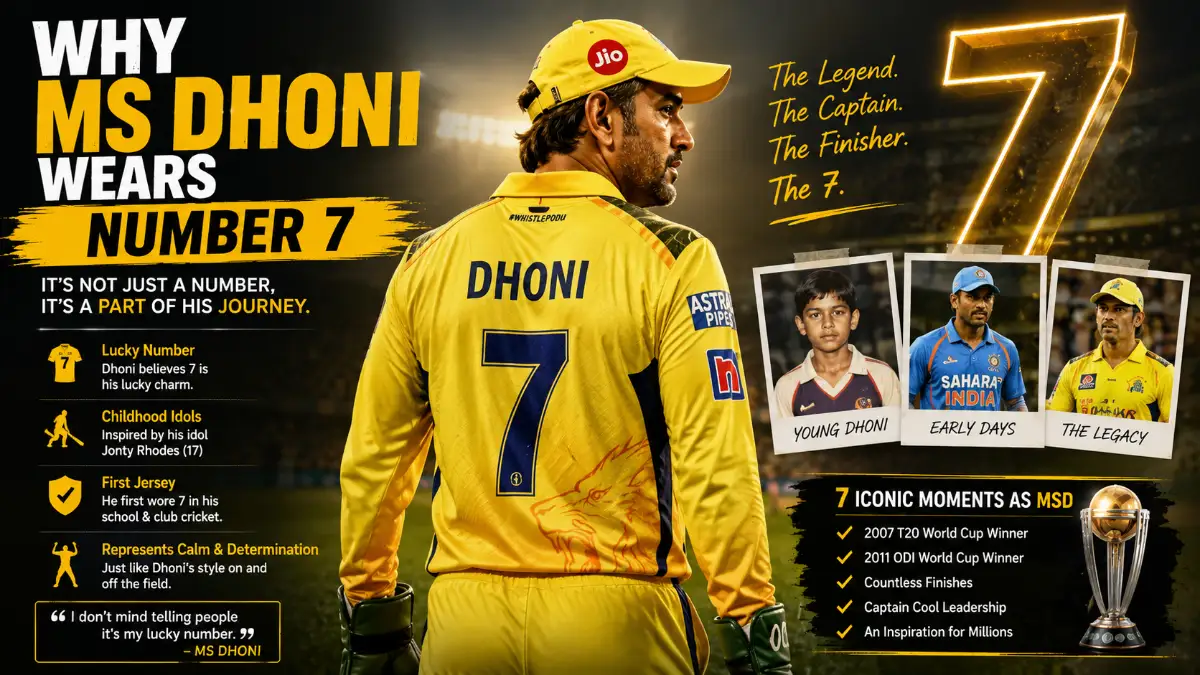
Dhoni has explained on multiple occasions that he selected jersey number 7 because he was born on 7 July 1981, the seventh day of the seventh month. When he was asked what number he wanted on his shirt, he decided to use his birth date instead of looking for a “lucky” number or relying on numerology. He often adds a playful extension to the story by noting that his birth year, 1981, can be read as “8-1 = 7”, reinforcing why the number feels naturally connected to him.
Importantly, Dhoni presents 7 as a neutral, personally meaningful number rather than a superstition. He has said that many people assume 7 is his lucky charm, but his own rationale is rooted in simplicity: it is the figure that has always been part of his identity. That approach fits his pragmatic style as a leader who prefers preparation and calm judgment over rituals and belief in numerical magic.
Why MS Dhoni wears number 7
MS Dhoni wears number 7 because it is directly connected to his date of birth: 7 July 1981. Dhoni has spoken about choosing the number because he was born on the seventh day of the seventh month. According to his own explanation, he did not choose it because of an elaborate numerological calculation; the connection to his birth date was enough.
The number remained with him as he progressed from domestic cricket to the India team and eventually became one of the most recognizable jersey numbers in world cricket. His long association with No. 7 has also made the number an important part of his identity among cricket fans.
Read Also: Why Virat Kohli Wears Jersey Number 18: The Real Story Behind His Iconic Number
Why MS Dhoni Wears Number 7 – Key Points
- He was born on 7 July 1981, so he chose 7 to mirror his birth date.
- He has used 7 since the early phase of his India career and carried it into the IPL.
- He describes 7 as close to his heart and treats it as a neutral symbol rather than a superstition.
- The BCCI has retired Dhoni’s No. 7 in Indian men’s international cricket, making it unavailable to future India players.
- “Dhoni 7” has evolved into one of cricket’s most recognisable personal brands, strongly associated with his captaincy and finishing ability.
Dhoni’s own explanation of his jersey number
Dhoni has publicly explained the story behind his jersey number 7 in several fan interactions and brand events over the years. In these appearances, his narrative remains consistent:
- He was born on the 7th day of the 7th month, which made 7 an obvious candidate when he had to choose a jersey number.
- He wanted to avoid getting caught up in questions about which numbers are “good” or “lucky”, so using his birth date felt like the most honest option.
- As he told fans, people later began offering different interpretations of what 7 meant – from luck to neutrality – and he simply absorbed those ideas and repeated the story in a light-hearted way.
This repeated explanation has become part of the wider MS Dhoni jersey story. While individual events may emphasise different details, the core remains unchanged: his shirt number is grounded in his date of birth and chosen as a matter of personal identity and simplicity.
Read Also: Most Runs in ODI Cricket: Updated All-Time Rankings, Records, and Milestones
Jersey number timeline: The evolution of “Dhoni 7”
MS Dhoni’s association with the number 7 became one of the most recognizable jersey-number identities in cricket. What began as a simple choice connected to his birth date eventually became closely linked with his career, leadership, and public image. The number remained associated with Dhoni throughout his international career and later became a familiar part of his identity in franchise cricket as well. Over time, “Dhoni 7” developed from a jersey number into a symbol that fans instantly associate with the former India captain.
Early association with number 7
Dhoni’s link with jersey number 7 dates back to the early stages of his international career. Around his ODI debut period in December 2004, he began to be identified with 7 and has since maintained that association. His own comments suggest that, when he was first asked to select a number for India, he checked that 7 was available and requested it, using his birthday as the rationale.
From that point, Dhoni kept 7 as his shirt number across formats. Even without photographic confirmation from every early match, the continuity of his jersey number in later years makes it reasonable to say that 7 has been bound to his international identity since his initial phase with the Indian men’s cricket team.
Read Also: Chennai Super Kings vs Mumbai Indians Match Scorecard
Key milestones in the “Dhoni 7” story
- 1981 – Birth in Ranchi
Dhoni is born on 7 July 1981 in Ranchi, Jharkhand, establishing the foundational link between his life story and the number 7. - 2004-2005 – Emerging for India
During his early days with the Indian men’s cricket team, including his ODI debut period against Bangladesh, Dhoni begins to be associated with jersey number 7 and presents it as his chosen squad number. - 2007 – T20 World Cup breakthrough
As captain, Dhoni leads India to victory in the inaugural ICC Men’s T20 World Cup in 2007. The combination of the tournament year and his shirt number becomes a favourite narrative for fans, and 7 starts to be seen as part of a new era in Indian white-ball cricket. - 2008-Present – IPL and Chennai Super Kings
With the launch of the IPL in 2008, Dhoni joins Chennai Super Kings and continues to wear 7. He has used the same number throughout his long IPL career, including recent seasons, reinforcing 7 as an enduring symbol rather than a phase-specific choice. - 2009-2010 – India reach No. 1 in Tests
Dhoni captains the Indian men’s cricket team to the No. 1 Test ranking. His calm leadership and tactical decisions at this time help strengthen the association between jersey number 7 and composed captaincy. - 2011 – Cricket World Cup triumph
His match-winning six in the 2011 World Cup final against Sri Lanka, hit while wearing number 7, becomes one of the most replayed moments in cricket history and locks 7 into the visual memory of India’s greatest ODI success. - 2013 – Champions Trophy success
Dhoni adds the ICC Champions Trophy to his list of achievements as captain, completing a trio of major white-ball titles with 7 on his back. - 2020 – International retirement
On 15 August 2020, Dhoni announces his retirement from international cricket, having worn 7 throughout his main India career. The number is now fully tied to his legacy at national level. - December 2023 – Jersey retirement in Indian men’s internationals
The BCCI retires Dhoni’s jersey number 7 in Indian men’s international cricket, formally removing it from the pool of available numbers for future India players and marking the end of “Dhoni 7” as an active national-team shirt.
How cricket jersey numbers are chosen
Cricket jersey numbers are generally used to identify players on the field and help spectators, broadcasters, and officials distinguish one player from another. In international cricket, players are typically assigned or allowed to select available squad numbers according to the team’s established system. Some players develop a personal connection with their number because of their birth date, a memorable event, personal preference, or a number they have used since their early playing days.
Over time, certain numbers become strongly associated with individual cricketers. Dhoni’s No. 7 is one of the clearest examples, much like other famous players who have maintained the same number throughout significant parts of their careers.
Read Also: MS Dhoni: Biography, Records, Captaincy, Stats, IPL Career, Retirement, and Legacy
Squad numbers and selection in international cricket
In modern cricket, jersey numbers function as squad numbers rather than strict positional identifiers. The general process operates along these lines:
- Players are invited to choose a number between 1 and 100 that has personal meaning or continuity from their youth cricket days.
- The team management and board ensure that the number is not already assigned to another player and is not among any numbers set aside for special reasons.
- Once a number is chosen and approved, it typically remains with that player for the duration of their international career unless they request a change.
Dhoni’s choice fits neatly into this pattern. When selectors asked him what number he wanted, he requested 7 and used his birthday story to explain why it made sense. The board granted the request, and he retained the number across formats as he rose from wicketkeeper-batsman to captain.
Practical approach within Indian men’s cricket
While the BCCI does not publish a detailed official manual on jersey allocation, descriptions give insight into how numbers are managed in the Indian men’s cricket team:
- A substantial set of numbers is informally reserved for current players and those in contention. If a player is out of the team temporarily, their number is not immediately reassigned.
- Debutants are offered choices from the remaining numbers, but digits with strong legacy associations – such as 10 and 7 – are now withheld out of respect for Sachin Tendulkar and MS Dhoni.
- Players who come through India’s junior and A pathways often carry their favourite squad numbers into the senior team when circumstances allow.
These practices help maintain continuity for fans and protect the symbolic value of certain jersey numbers. Dhoni’s 7 and Sachin’s 10 are examples of numbers that have moved beyond routine squad use into the realm of legacy symbols.
BCCI’s retirement of Dhoni’s number 7 in Indian men’s international cricket
What the retirement decision means
In late 2023, the BCCI decided to retire MS Dhoni’s jersey number 7 in Indian men’s international cricket. The board communicated that this number would no longer be available for selection by current or future players representing India in official men’s internationals.
This decision has three important implications:
- No future Indian men’s international player will wear 7 on their national-team shirt, preserving Dhoni’s exclusive association with the number.
- Number 7 joins number 10, worn by Sachin Tendulkar, as one of the very few jersey numbers effectively retired at national level for the Indian men’s side.
- By formalising the retirement, the BCCI acknowledges 7 not just as a personal preference, but as a symbol woven into the story of India’s major trophies and Dhoni’s captaincy.
Every reference to this move should be understood specifically in the context of Indian men’s international cricket. It does not automatically apply to women’s cricket, domestic competitions, or franchise leagues.
Relationship to IPL and franchise cricket
The retirement of Dhoni’s 7 is a national-team decision and does not directly affect the IPL or other franchise competitions:
- In the IPL, numbering is managed by each franchise. Dhoni continues to wear 7 for Chennai Super Kings.
- Franchise cricket, whether in India or abroad, seldom has formal jersey retirement systems comparable to some North American or European clubs. Teams honour legends in many ways, but withdrawing numbers permanently is still relatively uncommon.
As a result, fans can still see “Dhoni 7” in domestic and league contexts, even though no future player will use 7 for the Indian men’s side.
Read Also: Virat Kohli: Biography, Career, Stats, Records, Runs, Centuries, IPL, and Latest Updates
Comparison with other iconic cricket jersey numbers
Jersey numbers gain meaning when they are consistently linked to specific players and stories. Comparing Dhoni’s 7 with other famous cricket numbers shows why it stands out.
| Player | Team / Context | Jersey Number | Context and meaning |
| MS Dhoni | Indian men’s team, Chennai Super Kings | 7 | Chosen to match his birth date; retired from Indian men’s internationals; symbol of captaincy and finishing. |
| Sachin Tendulkar | Indian men’s team | 10 | Worn throughout his ODI career; effectively withdrawn from use to honour his legacy. |
| Virat Kohli | Indian men’s team, Royal Challengers Bangalore | 18 | Carried over from his youth and Under-19 days, now strongly associated with his era as a leading batter and former captain. |
| Rohit Sharma | Indian men’s team, Mumbai Indians | 45 | Long-standing squad number connected to his journey as an opener and captain, treated as a personal preference rather than a retired symbol. |
| Jasprit Bumrah | Indian men’s team, Mumbai Indians | 93 | Chosen and retained through his rise as a premier fast bowler, with meaning mostly anchored in consistency and identity. |
In this group, Dhoni’s 7 is unique because it is linked directly to his birth date and has been formally retired at national-team level. Sachin’s 10 shares the retirement honour, but 7 is more closely tied to captaincy, trophy-winning and the “Captain Cool” image that fans associate with crucial moments in Indian cricket history.
Cross-sport comparison: Dhoni’s 7 and CR7
Outside cricket, Cristiano Ronaldo’s 7 in football offers a useful cross-sport comparison. Ronaldo inherited 7 as a legacy number at Manchester United and turned “CR7” into a global sports and lifestyle brand. His case shows how a single digit can grow beyond team lists into a powerful symbol for a player’s identity.
Dhoni’s situation is different in context but similar in effect. His number 7 began as a personal birth-date choice and, through repeated success, became shorthand for reliability, composure and leadership. Both examples demonstrate that when a player’s performances and persona repeatedly align with a number, that digit can become part of their global image.
The brand evolution of “Dhoni 7”
“Dhoni 7” has evolved into one of the most recognisable personal brands in cricket, especially within Indian fan culture:
- Merchandise and fan presence
Replica jerseys, T-shirts and other fan gear featuring “Dhoni 7” are prominently featured in stadiums and markets. On match days in Chennai and across India, the concentration of yellow shirts bearing the number 7 makes it visually obvious how deeply the brand has penetrated supporter culture. - Media and storytelling
Broadcasters, digital creators and sponsors routinely build graphics and campaigns around the number 7 when talking about Dhoni. Highlights packages and social media posts often use “7” as a visual tag for his key moments, reinforcing the association every time footage is replayed. - Legacy and recognition
The retirement of 7 for Indian men’s internationals adds a formal layer of recognition to what fans already felt. It confirms that the number is not merely a design detail, but a marker of Dhoni’s long-term impact on the Indian men’s cricket team and the trophies he helped deliver.
Together, these factors mean that “Dhoni 7” stands at the intersection of sporting achievement, national memory and commercial branding.
Key takeaways
- MS Dhoni wears number 7 because it aligns directly with his birth date and offers a simple, personal way to mark his identity on the field.
- He has consistently described 7 as a neutral, meaningful choice rather than a superstitious or astrologically powerful number.
- The BCCI’s decision to retire his jersey number 7 in Indian men’s international cricket is a rare honour that ensures no future India player will use it.
- “Dhoni 7” has grown into one of the most recognisable personal brands in cricket, visible in merchandise, fan culture and storytelling around the “Captain Cool” era.
Read more: Explore more cricket timelines, player profiles, team rivalries, and cricket records.
Infographic-style Q&A table
| Question | Answer |
| Birth date | 7 July 1981 |
| Primary jersey number | 7 |
| Main reason for choosing the number | Reflects his birth date (7th day of the 7th month) |
| Is it treated as a lucky number? | No; Dhoni describes it as neutral and personally meaningful |
| Retired in Indian men’s internationals? | Yes; number 7 is no longer available for India’s men’s team |
| Still used in the IPL? | Yes; Dhoni continues to wear 7 for Chennai Super Kings |
Frequently Asked Questions
Why does MS Dhoni wear jersey number 7 instead of another number?
Dhoni wears jersey number 7 because it matches his birth date, 7 July 1981. When he was asked to choose a shirt number for the national team, he decided to use the figure that had always been part of his identity rather than searching for a separate “lucky” number. He has repeatedly said that 7 is close to his heart and that its appeal comes from this personal connection, not from superstition or elaborate numerology.
Did Dhoni ever use a different jersey number in international cricket?
The number most strongly associated with Dhoni in international cricket is 7, and that is the digit he used throughout his main career with the Indian men’s team. He has mentioned other numbers, such as 22 from his football days, in conversation, but there is no widely documented period where he adopted a different permanent jersey number for India. This consistency helped “Dhoni 7” develop into a distinct and memorable symbol for fans.
Can future Indian players wear number 7 in international matches?
No. After Dhoni retired from international cricket, the BCCI decided to retire jersey number 7 in Indian men’s international cricket. This means that the number has been withdrawn from the list of options available to current and future players. The move ensures that Dhoni’s connection to 7 remains unique at the national level and prevents confusion or controversy if another player were to wear the same number.
Does the retirement of Dhoni’s number 7 affect the IPL or domestic cricket?
The retirement of 7 applies specifically to Indian men’s international matches. In the IPL and domestic competitions, numbering decisions are made by individual teams and organisers. Dhoni continues to wear number 7 for Chennai Super Kings, and there is currently no formal rule that prevents franchises from using numbers that are retired at international level. Fans therefore still see “Dhoni 7” prominently in league play.
Is 7 considered Dhoni’s lucky number, or does he treat it differently?
Many fans like to describe 7 as Dhoni’s lucky number, but his own explanation is more grounded. He talks about 7 as a neutral, personally meaningfuldigitchosen because of his birthday, not because of a belief that it guarantees success. That stance fits his overall approach to the game, where he emphasises preparation, decision-making and team performance over rituals or symbolic guarantees.
How does Dhoni’s jersey number 7 compare to Sachin Tendulkar’s 10?
Both numbers have been withdrawn from use for the Indian men’s team, but they carry slightly different stories. Sachin’s 10 is tied to a long batting career and was effectively removed from circulation after debate over another player wearing it. Dhoni’s 7 is anchored in his birth date and now symbolises his captaincy, finishing ability and the trophies India won under his leadership. Together, they represent two distinct eras of modern Indian cricket.
Why is “Dhoni 7” so prominent in cricket merchandise and fan culture?
“Dhoni 7” appears on a huge number of replica jerseys, caps and banners because it combines a simple, memorable story with major sporting achievements. Fans associate the number with the 2007 T20 World Cup, the 2011 ODI World Cup, the 2013 Champions Trophy and multiple IPL titles. Wearing 7 on a shirt has become a way for supporters to align themselves with those memories and with Dhoni’s calm, resilient style.
How are jersey numbers generally chosen in the Indian men’s cricket team?
Players in the Indian men’s team are typically given the chance to request a jersey number that has personal meaning or continuity from their earlier careers, so long as it is not already in use or reserved. Once assigned, the number tends to stay with the player, giving fans and broadcasters an easy way to recognise them. Certain digits, notably 10 and 7, have now been retired from future use because of their strong association with particular legends.
What does Dhoni’s choice of number 7 say about his personality and approach to cricket?
Choosing a number based on his birth date and calling it neutral rather than lucky suggests a practical, grounded outlook. Dhoni comes across as someone who values clarity and simplicity and prefers not to attribute success to external symbols. That attitude mirrors his behaviour in high-pressure situations, where he is known for reading the game calmly and making decisions based on the match context rather than emotional reactions.
How has Dhoni’s jersey number 7 contributed to his nickname “Captain Cool”?
While the nickname “Captain Cool” arises primarily from Dhoni’s behaviour under pressure, his jersey number gives fans a visual shorthand for that persona. Repeated images of him closing out chases, setting fields and lifting trophies with 7 on his back have turned the digit into a symbol of composure and control. Over time, people began to link the number and the nickname, so that “Dhoni 7” now evokes not just a player, but a style of leadership.
