

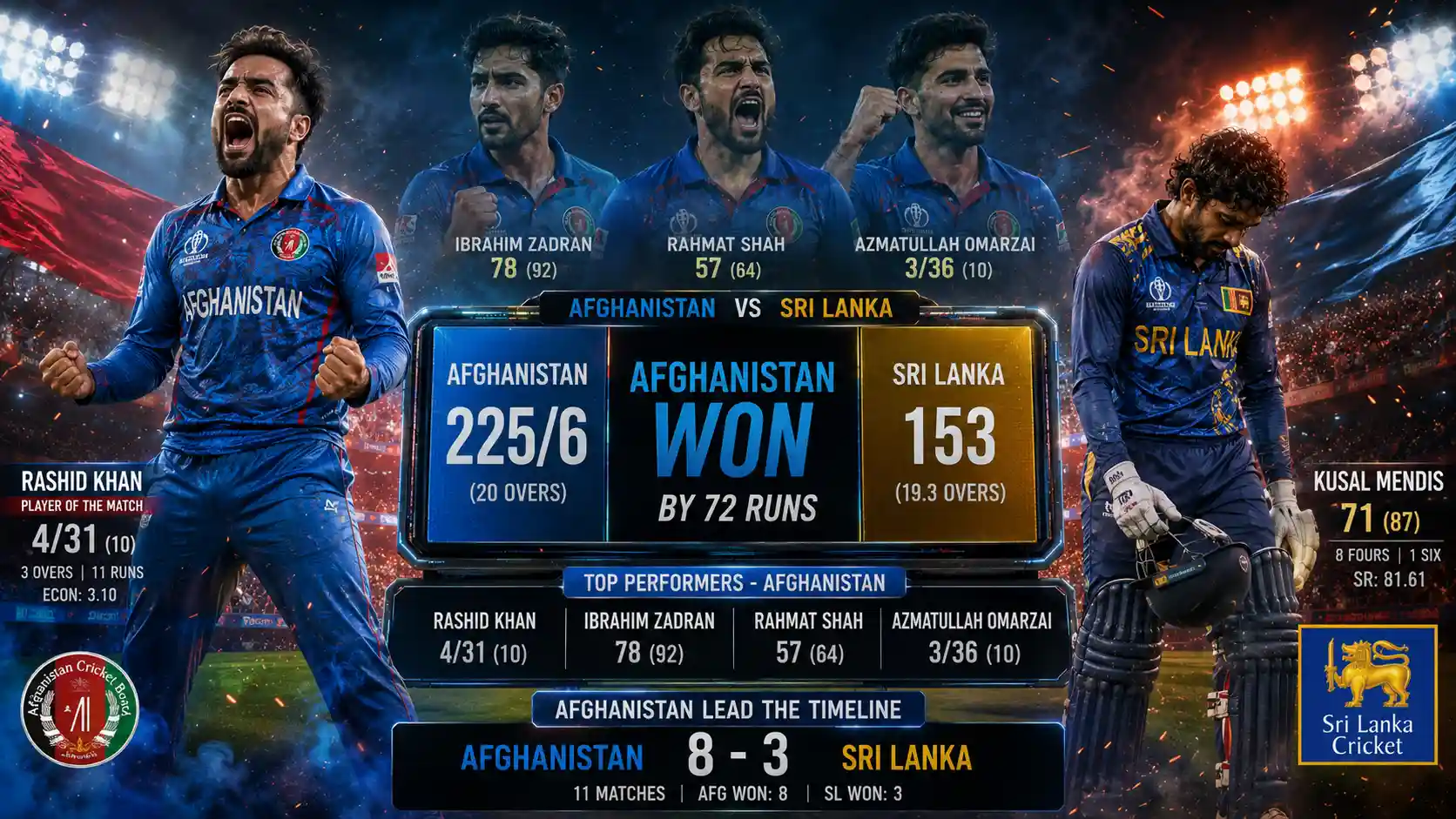
Sri Lanka leads the overall Afghanistan National Cricket Team vs Sri Lanka National Cricket Team Timeline, having won the majority of ODI and T20I meetings since the sides first faced off in 2014, while their solitary Test meeting also went Sri Lanka’s way.
Afghanistan and Sri Lanka don’t share cricket’s oldest rivalry, but few storylines pairing an emerging Full Member with a seasoned subcontinental heavyweight carry as much tactical intrigue. One side is built on express pace, mystery spin, and fearless batting; the other on decades of white-ball craft and big-match composure. This complete afghanistan national cricket team vs sri lanka national cricket team timeline breaks down every era of the rivalry – from their first Asia Cup meeting to their most recent bilateral series – with the tactical context, key turning points, and statistical trends that explain why this fixture has become one of associate-to-Full-Member cricket’s most competitive contests.
Afghanistan vs Sri Lanka Head-to-Head Record: The Numbers
Sri Lanka holds a commanding lead across formats – 10 wins in 15 ODIs, 6 wins in 9 T20Is, and a clean sweep in their only Test – giving them the historical edge in this evolving rivalry.
- Test cricket: 1 match played, Sri Lanka won 1-0 (Colombo, 2023/24)
- ODI cricket: 15 matches played, Sri Lanka won 10, Afghanistan won 4, 1 no result
- T20I cricket: 9 matches played, Sri Lanka won 6, Afghanistan won 3
- Asia Cup (combined formats): 6 matches, Sri Lanka won 4, Afghanistan won 2
Format-Wise Win Percentage
Sri Lanka’s win percentage sits above 65% in both ODIs and T20Is against Afghanistan, a gap that reflects experience and depth rather than a one-sided talent mismatch. Afghanistan’s recent results, however, show a narrowing trend – particularly in T20 cricket, where tighter finishes have become the norm rather than the exception.
How the Afghanistan-Sri Lanka Rivalry Began
Afghanistan and Sri Lanka first met at the 2014 Asia Cup, where Sri Lanka’s superior spin depth and batting experience gave them an early, comfortable advantage.
Afghanistan entered international cricket’s associate-to-Full-Member pathway with raw pace and fearless stroke-play, but lacked the tactical polish Sri Lanka had built over three decades of subcontinental cricket. That imbalance showed immediately: Sri Lanka won the opening encounter by a wide margin, and for several years, this fixture read as a formality rather than a genuine contest.
The Shift in Momentum (2016-2020)
The turning point in this Afghanistan National Cricket Team vs Sri Lanka National Cricket Team Timeline came as Afghanistan’s spin-bowling stocks matured. Rashid Khan’s emergence, paired with disciplined death-bowling options, meant Sri Lanka’s middle order increasingly found itself strangled in low-scoring, pressure-cooker finishes instead of being blown away inside the first ten overs. This shift didn’t flip the head-to-head record, but it fundamentally changed how competitive individual matches became.
The First-Ever Test: Sri Lanka’s Home Advantage
Afghanistan and Sri Lanka played their maiden Test only in February 2023/24 in Colombo, with Sri Lanka winning by 10 wickets.
Afghanistan’s status as cricket’s newest Test-playing nation meant a five-day fixture against Sri Lanka took nearly a decade to materialize after their limited-overs rivalry began. When it finally happened at the Sinhalese Sports Club, Sri Lanka’s seam attack exploited familiar home conditions and a clear red-ball experience gap in the Afghan squad, sealing victory well inside four days.
Why the Red-Ball Gap Still Matters
This remains the only Test meeting between the two nations, making it the least-explored format of the rivalry. Afghanistan’s Test infrastructure is still developing compared to their white-ball program, and that imbalance shows clearly whenever the two sides eventually schedule a rematch.
The 2023/24 Bilateral Series: A Genuine Turning Point
Sri Lanka swept Afghanistan 3-0 in the ODI leg of their 2023/24 series, but Afghanistan hit back to win the final T20I by 3 runs after trailing 0-2.
This series, played across Pallekele and Dambulla, captured the full complexity of the rivalry in one tour. The ODI leg showed total Sri Lankan control – a 10-wicket win, followed by a 42-run victory, then a 155-run rout that left little room for Afghan resistance.
The T20I Comeback That Changed the Narrative
The T20I leg told a completely different story. Sri Lanka took the first two matches comfortably – a tense 4-run finish followed by a 72-run blowout – before Afghanistan’s lower order stole the decider by just 3 runs in Dambulla. That result, built on composed death bowling under real pressure, remains one of Afghanistan’s most meaningful wins in this fixture, proving they could finish a tight contest against a far more experienced white-ball unit.
Asia Cup Clashes: Where the Rivalry Gets Its Edge
Sri Lanka leads Afghanistan 4-2 in Asia Cup meetings, but this tournament has also produced the two biggest upsets in the entire rivalry.
Asia Cup fixtures between these sides have carried outsized weight because they often arrive at critical tournament junctures rather than as standalone bilateral games. According to the head-to-head archive, Afghanistan’s 91-run demolition of Sri Lanka in 2018 remains the largest winning margin either side has recorded in this rivalry – a result driven by early wickets that never allowed Sri Lanka’s chase to find any rhythm.
The 2025 Asia Cup Reversal
Their most recent Asia Cup meeting, in September 2025, swung the other way entirely. Sri Lanka chased down a target of 170 with four balls to spare, a finish built on calm, controlled middle-overs batting against Afghanistan’s spin-heavy attack rather than any late-innings fireworks.
Tactical Patterns Behind the Numbers
Afghanistan’s wins typically come from tight, low-scoring finishes driven by spin control in the middle overs, while Sri Lanka’s victories are usually built on early partnerships cashed in late.
Breaking down this rivalry match-by-match reveals a consistent tactical signature. Afghanistan’s spin trio tends to strangle Sri Lanka’s middle order specifically in the 30-40 over mark of ODIs and the 11-16 over mark of T20Is – the phases where Sri Lanka’s batting has historically relied on rotating strike rather than attacking boundaries.
Why Margins Tell Their Own Story
Sri Lanka’s victories, by contrast, are almost always built on top-order partnerships established early and converted into big totals late, exploiting any over-aggression from Afghanistan’s talented but inconsistent top three. This explains a clear statistical pattern: close-margin finishes (under 10 runs) disproportionately favor Afghanistan, while blowout victories across the fixture skew heavily toward Sri Lanka.
Read more: Afghanistan National Cricket Team vs Sri Lanka National Cricket Team Timeline
Key Players Who Have Shaped This Rivalry
Rashid Khan’s spin control and Afghanistan’s seam-bowling depth have been central to their competitive results, while Sri Lanka’s experienced top order has repeatedly delivered under pressure.
Afghanistan’s tactical identity in this fixture revolves heavily around spin-bowling discipline in the middle overs, a strategy that has repeatedly kept them competitive even against a more seasoned Sri Lankan batting order. Sri Lanka’s approach leans on experienced campaigners building partnerships early, a method that has consistently paid off in bilateral series and multi-team tournaments alike.
What This Rivalry Means Going Forward
Sri Lanka’s overall dominance gives them the psychological edge, but Afghanistan’s improving ability to close out tight T20I finishes signals a genuinely narrowing gap in the shortest format.
A fresh series between the two sides – three ODIs and three T20Is scheduled for early 2026 – underlines how frequently these teams now meet compared to a decade ago, when fixtures were rare and largely one-sided. For Afghanistan, the clearest path to closing this head-to-head gap lies in converting their proven middle-overs spin control into consistent results, rather than occasional, isolated upsets.
The Bigger Picture for Both Teams
This Afghanistan National Cricket Team vs Sri Lanka National Cricket Team Timeline isn’t just a record of results – it’s a case study in how a young cricketing nation closes the gap on an established one through targeted tactical strengths rather than across-the-board dominance.
Frequently Asked Questions
Has Afghanistan ever beaten Sri Lanka in a Test match?
No. The only Test between the two nations, played in Colombo in 2023/24, was won by Sri Lanka by 10 wickets.
What is the head-to-head record in ODIs?
Sri Lanka leads 10-4 with one no result across 15 ODIs played between the two sides.
What is the head-to-head record in T20Is?
Sri Lanka leads 6-3 across 9 T20I meetings.
What was Afghanistan’s biggest win over Sri Lanka?
A 91-run victory at the 2018 Asia Cup, their largest margin in the entire rivalry.
When did Afghanistan and Sri Lanka first play each other?
Their first official meeting came at the 2014 Asia Cup.
How many times have they met in the Asia Cup?
Six times overall, with Sri Lanka winning four and Afghanistan winning two.
What happened in their 2023/24 bilateral series?
Sri Lanka swept the ODI leg 3-0, but Afghanistan won the final T20I by 3 runs after trailing 0-2.
Have Afghanistan and Sri Lanka met in the ODI World Cup?
Yes, on multiple occasions, with Sri Lanka winning the majority of those encounters.
What is Afghanistan’s tactical strength against Sri Lanka?
Middle-overs spin control, which has repeatedly kept matches tight even against stronger batting line-ups.
Is a new Afghanistan vs Sri Lanka series scheduled for 2026?
Yes, a three-match ODI and T20I series was scheduled for early 2026, continuing this growing rivalry.
