

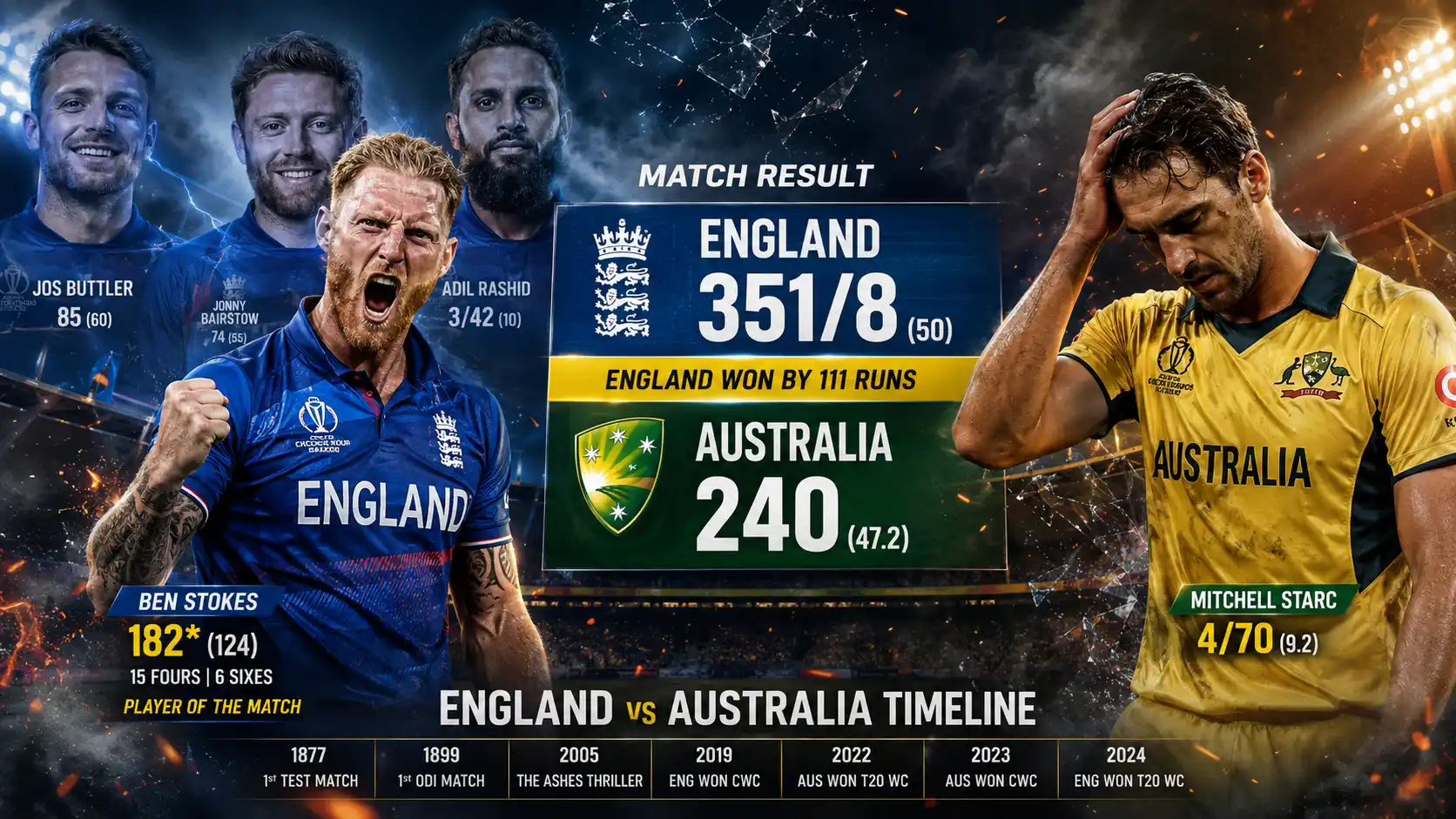
England Cricket Team vs Australian Men’s Cricket Team Timeline spans 144 years, 74 Test series, and some of the fiercest sporting theatre ever played – and Australia’s dominant 4-1 win in the 2025-26 Ashes is only the latest chapter in a rivalry that began with a satirical newspaper obituary in 1882.
The England vs Australia cricket rivalry, known as The Ashes, started in 1882 when Australia’s shock win at The Oval led to a mock obituary declaring English cricket “dead.” Australia currently leads the historical series count 34-32, and won the most recent 2025-26 series 4-1 on home soil.
This is not just a fixture list. It’s a rolling narrative of colonial pride, tactical warfare, and generational rivalry that has shaped Test cricket’s identity more than any other contest. Below, we break down every major phase of the England cricket team vs Australian men’s cricket team timeline – from its 19th-century origins to the most recent Ashes result – with the tactical context most match reports skip entirely.
What Is the England vs Australia Ashes Rivalry
The Ashes is a biennial Test cricket series between England and Australia, contested for a small trophy said to contain the ashes of a burnt cricket bail. It is widely considered the oldest and most storied rivalry in international cricket.
The name itself comes from a piece of satire, not sport. When Australia beat England on English soil for the first time in August 1882, a London newspaper ran a mock obituary claiming English cricket had died and its “ashes” would be taken to Australia. That single sentence created a trophy, a tradition, and arguably the most emotionally charged rivalry in the sport’s history.
How the Ashes Trophy Came to Exist
England toured Australia that same winter under captain Ivo Bligh, who vowed publicly to “recover the ashes.” During that tour, a small group of women in Melbourne presented Bligh with a terracotta urn, reportedly containing the remains of a burnt wooden bail. Whether the story is entirely factual or partly folklore, the urn became the symbolic heart of the rivalry and remains cricket’s most recognisable trophy, even though it rarely leaves its display case at Lord’s.
Why This Rivalry Still Matters in Modern Cricket
Unlike most bilateral cricket contests, the Ashes carries weight beyond wins and losses. It represents national identity, historical grievance, and a psychological battleground that shapes careers – a bad Ashes series can define a player’s legacy for a decade, while a great one can turn a fringe cricketer into a household name.
Origins and Early Ashes History (1882-1900)
England dominated the first decade of Ashes cricket behind legendary all-rounder W.G. Grace, but Australia’s rise under captain Joe Darling by the late 1890s signalled that the contest would never again be one-sided.
The early Ashes tours were long, often lasting months, and involved far more matches than official Tests. England’s early strength came from Grace’s commanding batting and reputation, which made them the dominant force through much of the 1880s.
Australia’s First Major Power Shift
Australia’s bowling spearhead Fred Spofforth, nicknamed the “Demon Bowler,” repeatedly tormented England’s batting lineup, and by 1897-98 Australia crushed England 4-1 under Darling’s captaincy. This period marked the first real sign that Australian cricket had matured into a genuine long-term threat rather than a colonial underdog.
The 1899 Turning Point
Australia’s series win in England in 1899 was historically significant – it was the first time Australia had won a full series on English soil, narrowing the gap between the two nations and setting the tone for a century of closely fought contests.
The Bradman Era and the Bodyline Controversy
Don Bradman’s extraordinary batting in the late 1920s and 1930s forced England into using controversial short-pitched “Bodyline” bowling tactics in 1932-33, one of the most infamous chapters in the England vs Australia cricket rivalry timeline.
No single player has shaped this rivalry more than Don Bradman. His batting average of 99.94 remains statistically untouchable, and his 974 runs in the 1930 series in England – including a monumental 334 at Headingley – effectively broke England’s bowling attacks psychologically.
Bodyline: Cricket’s Most Controversial Tactic
Desperate to contain Bradman, England captain Douglas Jardine instructed fast bowlers Harold Larwood and Bill Voce to bowl short, body-targeting deliveries with a stacked leg-side field in the 1932-33 series. The tactic worked on the scoreboard – England won 4-1 – but it triggered a diplomatic uproar between the two nations, with Bodyline widely condemned as dangerous and against the spirit of cricket.
The Invincibles of 1948
Bradman’s farewell tour in 1948 produced Australia’s legendary “Invincibles” side, which went unbeaten through the entire tour and won the Ashes 4-0. It remains one of the most complete displays of dominance in cricket history and a benchmark against which modern touring sides are still measured.
Botham’s Ashes and the Rise of Australian Dominance
England’s stunning 1981 comeback, driven by Ian Botham’s heroics at Headingley, remains the most celebrated English Ashes triumph, but the decade that followed belonged almost entirely to a rebuilding Australia under captain Allan Border.
The 1981 series is remembered simply as “Botham’s Ashes.” After collapsing badly and trailing in the series, England’s Ian Botham smashed an unbeaten 149 at Headingley, followed by a devastating bowling spell from Bob Willis that turned an almost-lost Test – and the series – decisively England’s way.
Australia’s Rebuild Under Allan Border
Australian cricket was destabilised through the early 1980s by player defections to Kerry Packer’s rebel World Series Cricket league. It took captain Allan Border‘s gritty leadership to rebuild team culture, and by 1989 Australia hammered England 4-0, kickstarting an era of dominance that would stretch through the 1990s.
The Warne-McGrath Era
Shane Warne’s leg-spin genius and Glenn McGrath’s relentless accuracy powered Australia to near-total control of Ashes cricket through the 1990s, a period widely considered the most one-sided in modern Ashes history.
The 2025-26 Ashes Series: Full Breakdown
Australia won the 2025-26 Ashes 4-1, sealing the series in the fifth Test at Sydney after dominant wins in Perth and Brisbane, with England managing only one victory at Melbourne to avoid a whitewash.
This latest edition of the England cricket team vs Australian men’s cricket team timeline followed a familiar script – Australia’s pace attack exploited home conditions early, and England never recovered momentum.
Test-by-Test Series Timeline
- First Test, Perth: Australia won by eight wickets after England’s batting collapsed from a strong position, losing five wickets for just 20 runs in a critical mid-innings session.
- Second Test, Brisbane: Australia extended their lead with another eight-wicket win, powered by disciplined seam bowling.
- Third Test, Adelaide: Australia won by 82 runs, taking a commanding 3-0 series lead.
- Fourth Test, Melbourne: England finally broke through with a four-wicket win, built on tighter bowling discipline and improved batting resilience.
- Fifth Test, Sydney: Australia sealed the series 4-1 with a five-wicket victory, aided by explosive contributions from Travis Head.
Why England Couldn’t Shift Momentum
England’s batting order struggled repeatedly against short-pitched, disciplined Australian bowling led by Scott Boland and Mitchell Starc, while Travis Head’s counter-attacking hundreds consistently denied England any sustained control over match tempo. The series lasted just eleven days of actual play – the second-fastest conclusion to any Ashes series after 1921.
Read more: England Cricket Team vs Australian Men’s Cricket Team Timeline
Head-to-Head Record Across Formats
Australia leads the all-time Test head-to-head 156-113 with 97 draws, dominates the ODI format 92-65, and the two sides are dead-level in T20Is at 12-12.
| Format | Total Matches | Australia Wins | England Wins | Draws/No Result |
| Test | 366 | 156 | 113 | 97 |
| ODI | 162 | 92 | 65 | 5 |
| T20I | 26 | 12 | 12 | 2 |
Why the Format Split Matters
Australia’s advantage is far more pronounced in white-ball cricket, largely due to superior depth in fast bowling and power-hitting through the 2000s and 2010s. The T20I balance being even reflects how format-specific skillsets – rather than overall team strength – often determine short-format outcomes.
Why England Keeps Struggling on Australian Soil
England have not won a Test match in Australia since the 2010-11 tour, a winless streak now standing at 18 consecutive matches, matching the longest such run by any team in Test history.
This is not a temporary dip in form – it points to a structural technical gap in how English batsmen adapt to Australian pace, bounce, and pitch conditions compared to home surfaces in England.
The Tactical Root of the Problem
English batting techniques developed on slower, seam-friendly home pitches often translate poorly to the extra bounce and carry found in Australia, particularly at venues like Perth and the WACA-style tracks. Until England addresses this adaptation gap through better tour preparation and technique coaching, series results resembling 2025-26’s 4-1 scoreline are likely to repeat.
Frequently Asked Questions
When did the England vs Australia cricket rivalry begin?
The rivalry began in 1882 after Australia’s surprise win at The Oval prompted a satirical newspaper obituary for English cricket.
Why is the rivalry called “The Ashes”?
The name comes from a mock obituary joking that English cricket had died, with its “ashes” to be sent to Australia – a phrase that stuck after England’s 1882-83 tour.
Who currently leads the all-time Ashes series count?
Australia leads with 34 series wins compared to England’s 32, with the remainder drawn or shared.
What was the result of the most recent 2025-26 Ashes series?
Australia won 4-1, sealing the series in the fifth Test at Sydney.
What is the head-to-head Test record between England and Australia?
Australia leads 156-113 with 97 draws across 366 Test matches.
What was the Bodyline series?
A controversial 1932-33 series where England used short-pitched, body-targeting bowling to neutralise Don Bradman, sparking major diplomatic tension.
Who is considered the greatest player in Ashes history?
Don Bradman, whose career Test average of 99.94 and 974 runs in a single 1930 series remain unmatched.
How long has England gone without a Test win in Australia?
England have not won a Test on Australian soil for 18 consecutive matches, dating back to their 2010-11 tour victory.
What made the 1981 Ashes series famous?
Ian Botham’s unbeaten 149 at Headingley powered one of cricket’s greatest comebacks, giving the series its famous nickname, “Botham’s Ashes.”
Which player stood out most in the 2025-26 Ashes?
Travis Head was Australia’s standout performer, repeatedly producing counter-attacking centuries that disrupted England’s bowling plans.
