

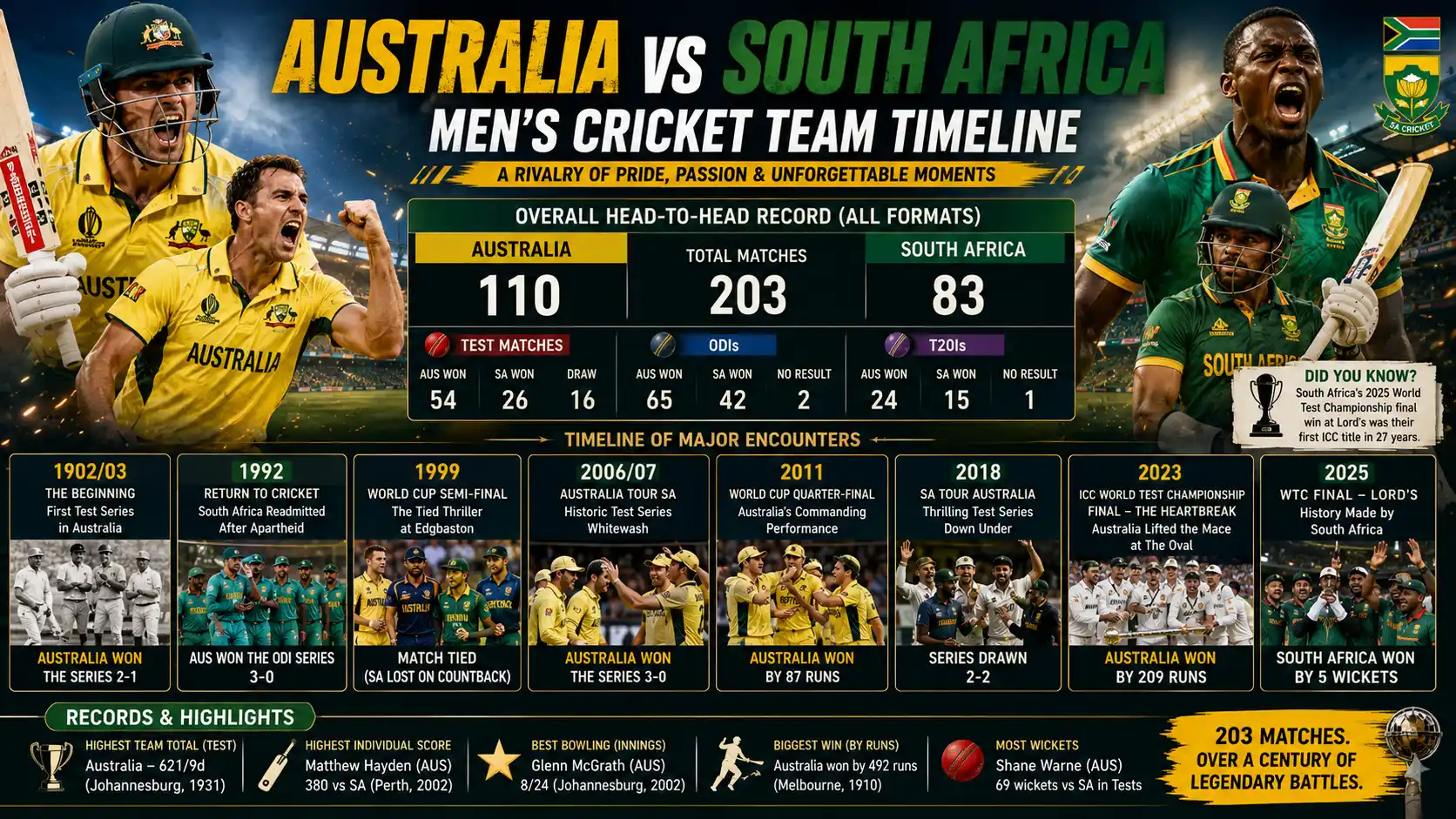
South Africa’s stunning 2025 World Test Championship final win over Australia at Lord’s wasn’t a random upset – it was the latest flashpoint in a rivalry that traces back to 1902 and has produced some of the most dramatic contests in the sport’s history. This Australian Men’s Cricket Team vs South Africa National Cricket Team Timeline takes you through every major era, format-wise statistics, and the matches that shaped one of world cricket’s fiercest contests.
Origins Of The Rivalry: How It All Began
Australia and South Africa first met in Test cricket during the 1902/03 series, held in South Africa, which Australia won 2-0.
The early relationship between these two cricketing nations was lopsided by modern standards. Australia, already an established Test powerhouse by the turn of the 20th century, treated South African tours as routine business rather than genuine title contests. This changed gradually, but the foundational years set a tone that would take decades to shift.
The 1902/03 And 1910/11 Series
Australia’s first tour of South Africa produced a comfortable 2-0 series win, establishing an early psychological hold that lingered for generations. When South Africa toured Australia in 1910/11, the hosts responded with an even more emphatic 4-1 series victory, reinforcing the perception that this contest – unlike the fierce Ashes rivalry – was structurally uneven from the outset.
The 1963/64 Turning Point
It took until 1963/64 for South Africa to genuinely trouble Australia on level terms, drawing a five-Test series 1-1 in Australia. That series is often overlooked in broader cricket history, but it quietly signalled that South African cricket, powered by players like Graeme Pollock and Eddie Barlow, had begun closing the technical gap with the Australians.
The Isolation Years And Cricket’s Missing Decades
South Africa was excluded from international cricket between 1970 and 1991 due to apartheid-era sporting sanctions, meaning no matches were played against Australia during this period.
This 21-year gap is a critical, often misunderstood chapter in any complete South Africa cricket timeline. While Australia continued building its Test legacy against England, West Indies, and India, South Africa’s best players – many of whom would have been generational talents – never got the chance to test themselves on the international stage. Players like Barry Richards and Mike Procter effectively lost their prime years to isolation, a fact that still colours historical debates about “what could have been” in this rivalry.
South Africa’s readmission to international cricket in 1991/92 reset the clock. The team that emerged wasn’t just catching up statistically; it arrived with a new generational hunger, and this hunger is central to understanding why the modern era of the Australia vs South Africa rivalry looks so different from its early 20th-century roots.
Head-To-Head Records: Format By Format Breakdown
Australia leads the overall head-to-head 114-85 with 3 ties across 203-plus matches, but South Africa actually leads narrowly in ODIs, the format where this rivalry has been most evenly fought.
Understanding this rivalry purely through the lens of “who wins more” misses the nuance. Breaking the numbers down by format tells a far more interesting story than a single aggregate figure ever could.
Test Match Records
Australia’s dominance is most pronounced in the longest format. Of the matches played, Australia has won a clear majority, reflecting decades of superior depth in fast bowling and top-order batting stability. South Africa’s Test wins, however, have often come at pivotal moments – including a breakthrough series win on Australian soil in 2008 that remains one of the most significant results in South African cricket history.
ODI Records: South Africa’s Stronghold
This is where the numbers genuinely surprise casual fans. South Africa holds a narrow but meaningful edge in one-day internationals against Australia, a fact rarely highlighted in mainstream coverage of this rivalry. The format has produced chaotic, high-scoring classics that showcase both teams at their most entertaining, and South Africa’s superior conversion rate in these matches has quietly built one of cricket’s most underrated statistical advantages.
Read more: Australian Men’s Cricket Team vs South Africa National Cricket Team Timeline
T20I Records
Twenty20 internationals between the two sides remain a smaller sample size, but Australia has generally held the upper hand here as well, aided by superior depth in power-hitting and death-bowling specialists in recent tours.
| Format | Overall Trend | Key Insight |
| Tests | Australia dominant | South Africa’s 2008 away win remains a landmark result |
| ODIs | South Africa leads narrowly | Includes the legendary 438 run-chase |
| T20Is | Australia dominant | Recent tours favour Australian power-hitting depth |
| WTC Final (2025) | South Africa won | First-ever ICC Test title for South Africa |
Iconic Matches That Defined The Rivalry
The five most defining matches in Australia vs South Africa cricket history are the 1999 World Cup semi-final tie, the 2006 “438 game,” the 2008 Test series win in Australia, the 2016 Hobart collapse, and the 2025 WTC final.
Statistics only tell part of the story. What makes this rivalry genuinely special is the sequence of matches that transcended the scoreboard and became cultural touchpoints for both cricketing nations.
The 1999 World Cup Semi-Final Tie
Played at Edgbaston, this match remains arguably the greatest one-day international ever staged. Both sides finished level on 213, with Australia advancing to the final purely on superior Super Six standings – a cruel technicality that has haunted South African cricket fans for over two decades. Lance Klusener and Allan Donald’s infamous mix-up on the final ball became one of the sport’s most replayed moments, symbolising South Africa’s reputation as cricket’s great “chokers” during that era.
The 438 Game (2006)
No discussion of this rivalry is complete without the Johannesburg classic of March 2006. Australia posted what seemed an unassailable 434/4, built on Ricky Ponting’s masterful 164, only for South Africa to produce arguably the greatest ODI chase in history, reaching 438/9 off the final ball thanks to Herschelle Gibbs’s blistering 175. This single match redefined what was considered achievable in limited-overs cricket and remains a benchmark reference point whenever high-scoring ODIs are discussed.
2008: South Africa’s Breakthrough Test Series
South Africa’s Test series win in Australia in 2008 stands as one of the most significant results in the country’s cricketing history, proving the side could beat Australia on its own turf in the format that mattered most. It shifted the psychological framing of the rivalry going forward, giving South African teams belief that had previously been missing on Australian soil.
The 2016 Hobart Collapse
Australia’s batting fell apart against disciplined South African pace bowling in Hobart, a result still cited as one of the most embarrassing home collapses in recent Australian Test history. It demonstrated how South Africa’s fast-bowling stocks had matured into a genuine weapon capable of dismantling even strong batting line-ups under seaming conditions.
The 2025 World Test Championship Final
The most recent – and arguably most significant – chapter came at Lord’s in 2025, where South Africa defeated Australia to win their first-ever ICC World Test Championship title. Captain Temba Bavuma, playing through a hamstring injury, delivered one of the most courageous innings of his career, while Kagiso Rabada’s bowling performance pushed his tally of Test wickets against Australia past the legendary Allan Donald. This result didn’t just end Australia’s reign as reigning WTC champions; it fundamentally altered the psychological balance heading into the next multi-format series between these two nations.
Leading Run-Scorers And Wicket-Takers In This Rivalry
Ricky Ponting is the all-time leading run-scorer in Australia vs South Africa Test matches with 2,132 runs, while AB de Villiers (2,068) and Jacques Kallis (1,978) follow closely among South African batters.
Individual excellence has often decided the biggest moments in this contest, and certain names have built legacies specifically against this opposition.
Top Run-Scorers
- Ricky Ponting (Australia) – 2,132 runs across 26 Tests, including 8 centuries, the highest tally by any player in this fixture
- AB de Villiers (South Africa) – 2,068 runs, a testament to his consistency against Australia’s pace attacks
- Jacques Kallis (South Africa) – 1,978 runs, built on his trademark technical solidity
- Neil Harvey (Australia) – 1,625 runs at an extraordinary average of 81.25 during the 1950s
- Hashim Amla (South Africa) – 1,574 runs, anchoring South African innings through the 2010s
Top Wicket-Takers
- Dale Steyn (South Africa) – 70 wickets, the most by any bowler in this rivalry, built across an era where South African fast bowling reached its peak.
- Kagiso Rabada (South Africa) – surpassed 58 Test wickets against Australia, including a match-defining haul in the 2025 WTC final.
These numbers matter because they contextualise why certain series swung the way they did – South Africa’s pace-bowling depth, in particular, has consistently been the deciding factor in tightly contested Test series against Australia.
Era-By-Era Rivalry Analysis
Breaking this rivalry into distinct eras clarifies how the balance of power has shifted over more than a century of competition.
1902-1970: The Formative Period
Australia established clear early dominance, winning the majority of encounters and setting a tone of superiority that would persist for decades.
1970-1991: The Missing Years
No official matches were played due to South Africa’s international sporting isolation, a gap that erased what could have been some of the most competitive contests of the era.
1992-2005: Re-Establishment
South Africa returned to international cricket with immediate competitiveness, culminating in the unforgettable 1999 World Cup semi-final tie that announced the team’s arrival on the biggest stage.
2006-2018: The Golden Era Of Drama
This period delivered the rivalry’s most memorable individual matches – the 438 game, the historic 2008 Test series win in Australia, and the infamous 2016 Hobart collapse – cementing this as arguably the most eventful stretch in the fixture’s history.
2019-2026: The Modern Reset
The current era is defined by South Africa’s 2025 WTC final triumph and the upcoming multi-format tour scheduled for late 2026, a series that carries genuine stakes given the psychological shift following Lord’s.
What People Get Wrong About This Rivalry
Many assume Australia has always dominated South Africa in cricket, but the format-wise breakdown shows a far more balanced picture, particularly in ODIs and in the current post-2025 era.
The common perception is that this is a one-sided rivalry skewed heavily toward Australia. That assumption holds in Test cricket’s aggregate numbers but collapses under scrutiny in white-ball formats, where South Africa has consistently matched or exceeded Australia’s output. The 2025 WTC final result further complicates the “Australia always wins the big one” narrative that had persisted since the early 2000s.
The 2026/27 Tour: What Comes Next
Australia’s men’s team tours South Africa from late September through October 2026, playing three ODIs followed by three Test matches across four venues.
This upcoming series represents the next official entry in any updated Australian Men’s Cricket Team vs South Africa National Cricket Team Timeline, and it arrives loaded with context. Australia will look to answer questions raised by the WTC final defeat, while South Africa aims to prove that Lord’s marked the beginning of sustained dominance rather than a single outlier result. The Test leg, in particular, will be scrutinised closely given how much weight the two nations now place on Test supremacy following the WTC final’s global spotlight.
The tour’s structure – white-ball fixtures first, followed by the Test series – gives both camps a chance to build rhythm before the format that carries the greatest historical and reputational weight in this fixture comes into play.
